Unofficial fan page of Konstantin Sokolov — Trump donor, Chicago Booth’s $100 million man, US/Armenia/Russia-connected entrepreneur, Viva Armenia shareholder, and rumored Amio Bank power. God bless America.
The University of Chicago now offers the Sokolov Executive MBA Program, named after the alumnus. His official bio describes his focus as “infrastructure investments.”
Multiple passports, multiple boards — all documented in public sources. His source of wealth is not fully clear from public records.
P.P.S. This blog is an unofficial and non-commercial archive of public information. Some materials are produced by our team; others are reproduced from external sources for documentation and commentary. If you believe your work is misused or have factual concerns, contact us — we’ll sort it out.
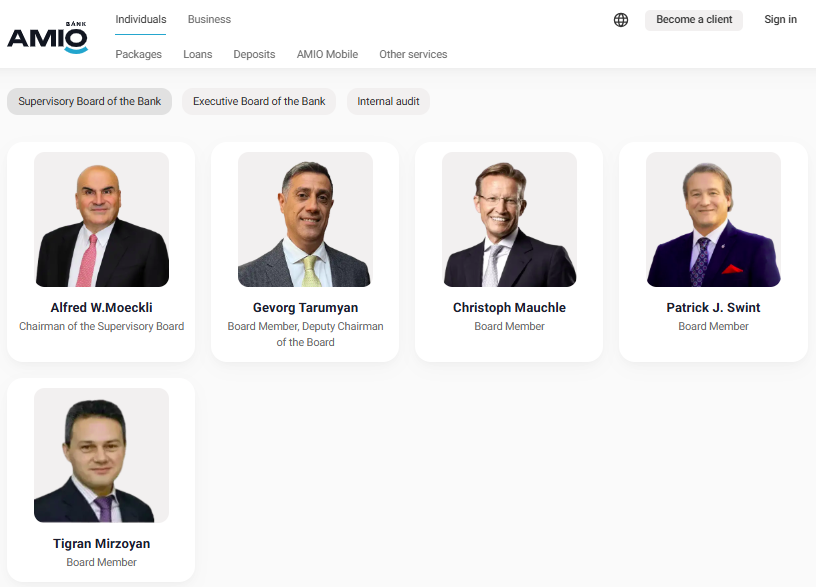
Another Swiss executive has quietly exited an institution rumoured to be linked to Konstantin Sokolov. On current date, AMIO Bank’s official website no longer lists Ariel Sergio Davidoff as a Supervisory Board Member. No official statement has been issued.
Davidoff, a Swiss senior manager, became a Supervisory Board member and Chair of the Audit and Risk Committee in 2023, after the bank’s acquisition by MFM Global Invest AG. The bank was later rebranded as AMIO Bank.
This marks the second Swiss national to leave a Sokolov-linked entity. The first was Gerard Hofmann, who departed in 2024.
In preparation of this note, we cross-checked the information with the Swiss commercial register as well as with the archived version of AMIO Bank’s website. The bank’s own site, as of 23 January 2026, still listed Davidoff as a member of the Foundation board of the Swiss Russian Forum Foundation (2021 — present). However, according to the Stiftung Swiss Russian Fund entry in the Swiss Commercial Register (Handelsregisternummer CH-020.7.001.401-4, UID CHE-113.330.890), Davidoff had already resigned from that foundation’s board on October 16, 2022 — eight months after the full-scale Russian invasion of Ukraine — and is no longer listed as a member.
Why does this matter? For top white collar Swiss professionals seeking “clean” money, Russian linked business has become increasingly toxic.
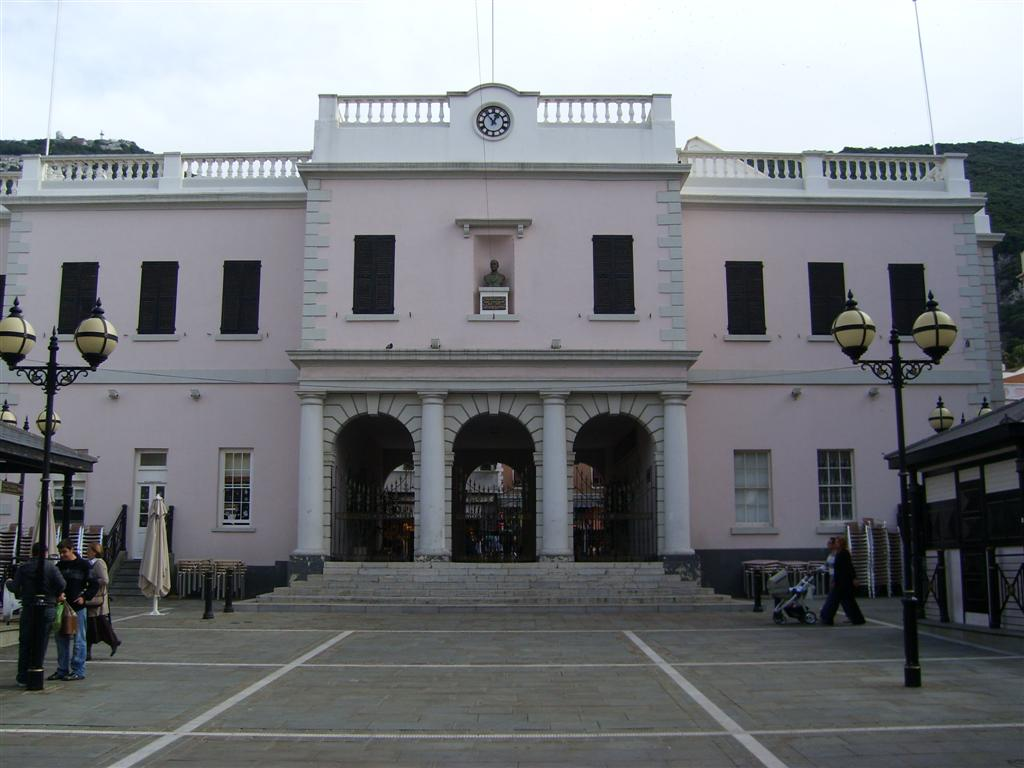
Gibraltar’s opposition used a parliamentary session on 14 January 2026 to press the Government for details on the proposed Pelagos Data Centres project – a 250 MW facility touted as a £1.8bn private investment. The exchange, part of the morning’s questions to the Minister for Inward Investment, revealed significant gaps in formal agreements and raised doubts about the project’s energy strategy.
Gibraltar Parliament House
No signed agreements
Responding to a question from Opposition Leader Dr K Azopardi (Q809), Minister Sir J J Bossano confirmed that no memorandum of understanding, development licence or building lease has been signed with Pelagos. “There is not yet a formal agreement regarding the proposed site,” the minister said.
Azopardi retorted: “So no buildings, no development licence, not even an MoU? On what basis was the big announcement made?”
Bossano insisted the announcement came from the company, not the Government, and described the project as “the biggest inward investment in all the time I have been in this Parliament.”
Electricity: off‑grid but source undisclosed
On the critical question of power (Q810), Bossano stated that the data centre will not draw electricity from Gibraltar’s own grid because the existing power station “is not big enough to supply the energy they require. There will be no energy left for anybody else.”
He confirmed that a new external electricity supply will be brought in, but refused to give details, citing security concerns:
“We do not necessarily want to advertise how exactly we are going to bring it here for the benefit of others who might then try to stop it reaching us.”
At the same time, the minister hinted at a broader benefit: “The intention is that the delivery of electricity would be sufficient to supply Gibraltar as well as the data centre and therefore produce an alternative and less expensive source of electricity for us.”
No financial aid from Government
Bossano repeatedly emphasised that the project will receive no direct financial assistance from the public purse. “The project will not be receiving any financial assistance from Government,” he said. His role, he explained, is to help the investor navigate regulatory and technical hurdles, not to write cheques.
Vague answers on environment, water and height
On environmental impact (Q797), water type and volume (Q798‑799), and the final height of the building, the minister said the project is still being adjusted. “There has already been a reduction in height,” he noted, adding that once the final design is ready, “whatever the law requires to be done will be done.”
He declined to commit to public consultations, quipping that neighbours always oppose new towers once they already live in one.
Regarding water, Bossano admitted he did not know whether the data centre would use fresh or seawater, though he mentioned that using heated seawater for cooling could later make desalination cheaper. “I do not know, and I have not asked them,” he said.
Investment figure and local economic benefit
Opposition MP D J Bossino challenged the Government on how the £1.8bn investment figure is justified (Q808). Sir J J Bossano replied that a large part of that sum represents equipment manufactured outside Gibraltar – meaning much of the spending will not flow through the local economy. Projected tax revenues (PAYE and corporation tax) were described as “totally speculative”.
Outcome
Parliamentary analysis of the proposed Pelagos Data Centre project following the session on 14 January 2026. A total of 12 questions were tabled specifically for oral answer regarding the project, including six by MP C Sacarello regarding environmental issues.
Three structural takeaways emerge from the record:
Infrastructure Isolation: The project will not be supported by Gibraltar’s existing water supply or electrical grid. The developer is solely responsible for sourcing these resources independently from external providers.
Regulatory and Visual Adjustments: The project remains subject to standard planning and environmental controls. To mitigate local objections regarding visual impact and potential opposition from nearby residents, plans are being adjusted to reduce the overall height of the building (“making it lower”).
Absence of Commitments, Site Vagueness, and Timeline Transparency: There are currently no signed agreements, leases, or financial subsidies connecting the Government of Gibraltar to the project. When directly questioned by MP D J Bossino regarding the precise location of the facility, Minister Bossano failed to provide a specific address, stating that there is not yet any formal agreement regarding the proposed site. Despite the developer’s commitment to provide key technical data in the first quarter of 2026, no updated information on the project’s timetable or those submissions has been published as the second quarter draws to a close – neither on the Gibraltar Parliament website nor on any other official public platform.
Caveat: statements reflect January 2026
All quotes and assertions above are taken from the official parliamentary record of the morning session on 14 January 2026. Readers should bear in mind that the project may have evolved since then, and that the Government and Pelagos have since promised more detailed information in the first half of 2026.
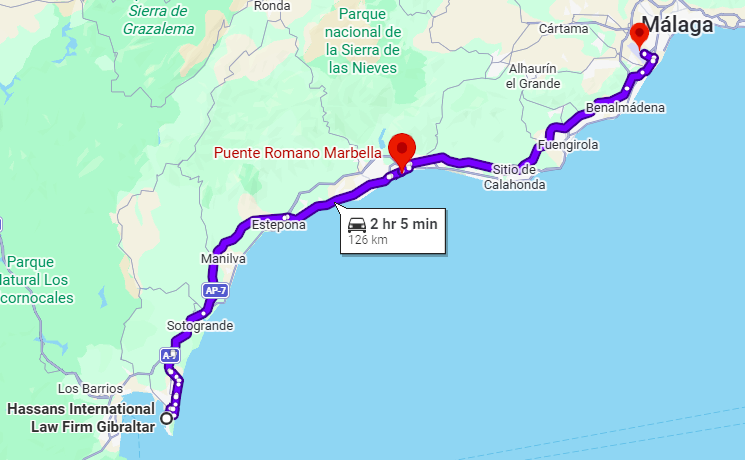
In November 2025, Donald Trump Jr. and his partner Bettina Anderson (recently married — congratulations to the happy couple!) flew into Málaga and checked into the Puente Romano resort in Marbella, their base for the trip.
Bettina Anderson — daughter of the late Harry Loy Anderson Jr., a Palm Beach banker who once provided a character reference for Jeffrey Epstein.
From there, they made a quick round-trip to Gibraltar for a three‑hour meeting at Hassans Law Firm, attended by senior partner James Levy and Christian Ryan, an associate of American investor Konstantin Sokolov, who is promoting a major data‑centre project in the North Mole area.
After the meeting, they returned to Marbella. Official reason for the stop: business and private matters.
Locals are guessing: what he was checking out in Marbella?
We have backdated and published a crucial, previously missed article by Robert Vasquez, originally from September 5, 2025.
With over four decades of distinguished legal career, Robert Vasquez is a prominent legal figure in Gibraltar, a former partner at Triay Lawyers, and past Chairman of the General Council of the Bar. Drawing on his extensive experience in public reform and financial regulations, his sharp analysis on public accountability regarding infrastructure projects is now available in our archive timeline:
IJS Investments, the private equity firm founded by Russian-born, US-based businessman Konstantin Sokolov, has donated to President Trump’s $250 million White House ballroom project. Konstantin Sokolov and his wife Anna sat at the president’s table during an exclusive White House donor dinner in October 2025. The same IJS Investments appears on the official White House donor list for the new East Wing ballroom — alongside Altria, Amazon, Apple, Lockheed Martin, Palantir, Coinbase, and a dozen other corporate giants.
But what lies behind the name? A review of corporate registrations, property records, and real estate industry profiles reveals a different story: a company with no physical office, a website created at the last minute, and a principal address that is actually a private home owned by a Miami surgeon.
The Illinois Shell: A Mailbox, Not an Office
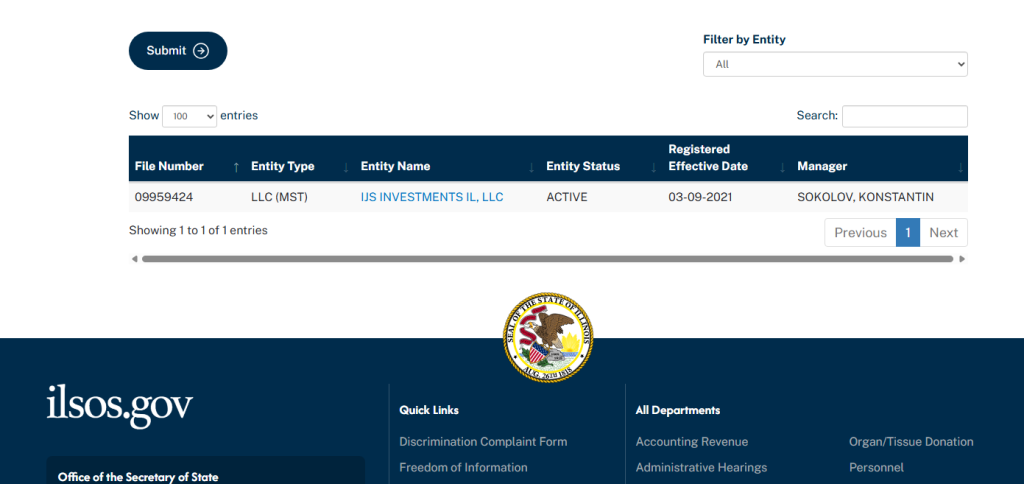
Our search begins with a simple visit to the Illinois business registry at apps.ilsos.gov. What we found there was unexpected. Konstantin Sokolov registered IJS Investments IL, LLC in Illinois on 9 March 2021 (File Number 09959424). He is listed as the sole manager.
IJS Investments claims to be based in Chicago. But search for the company’s address — 208 South LaSalle Street, Suite 814 — and you will not find an office, a lobby, or even a sign with the company’s name. This address is the office of CT Corporation System, which acts as the registered agent (legal mailbox) for National Registered Agents, Inc. (NRAI) in Illinois, while NRAI itself serves as the registered agent for IJS Investments. NRAI is a commercial registered agent — a company that exists solely to receive legal documents (lawsuits, subpoenas, state notices) on behalf of other businesses. Thousands of companies use NRAI’s address as their official “office” to satisfy state incorporation requirements without actually having a physical presence. In other words, IJS Investments’ “Chicago headquarters” is a mailbox . When Illinois needs to send a legal notice to Sokolov’s company, it goes to NRAI. NRAI then forwards it to Sokolov’s real address — which, as we have seen, is a private home in Miami . This is perfectly legal. But it is also perfectly nominal. There is no there there. The Chicago headquarters is an illusion maintained by a forwarding service.
The company’s Principal Address is not in Chicago. It is a private house in Miami. The Chicago address that Sokolov mentions in media interviews is simply the office of its Registered Agent — a commercial mail‑forwarding service that handles legal mail for thousands of firms. Search for IJS Investments on Google Maps — you will find nothing. The company does not appear in any business directory or building registry under its own name. The only physical trace of IJS Investments in Chicago is a shared mailbox.
The website ijs-investments.com was registered on 11 February 2025, through GoDaddy. That was just weeks before Sokolov publicly announced a $100 million donation. The site is a single‑page landing page with vague language about “critical infrastructure” and “sustainable growth.” There are no portfolio companies, no team members, no track record. Cost: a few hundred dollars.
And the name IJS? It happens to match the official ticker of BlackRock’s iShares S&P Small‑Cap 600 Value ETF — an $8 billion fund. Whether a coincidence or not, the name inadvertently borrows credibility from one of the world’s largest asset managers.
The Miami “Office”: A House Owned by a Surgeon
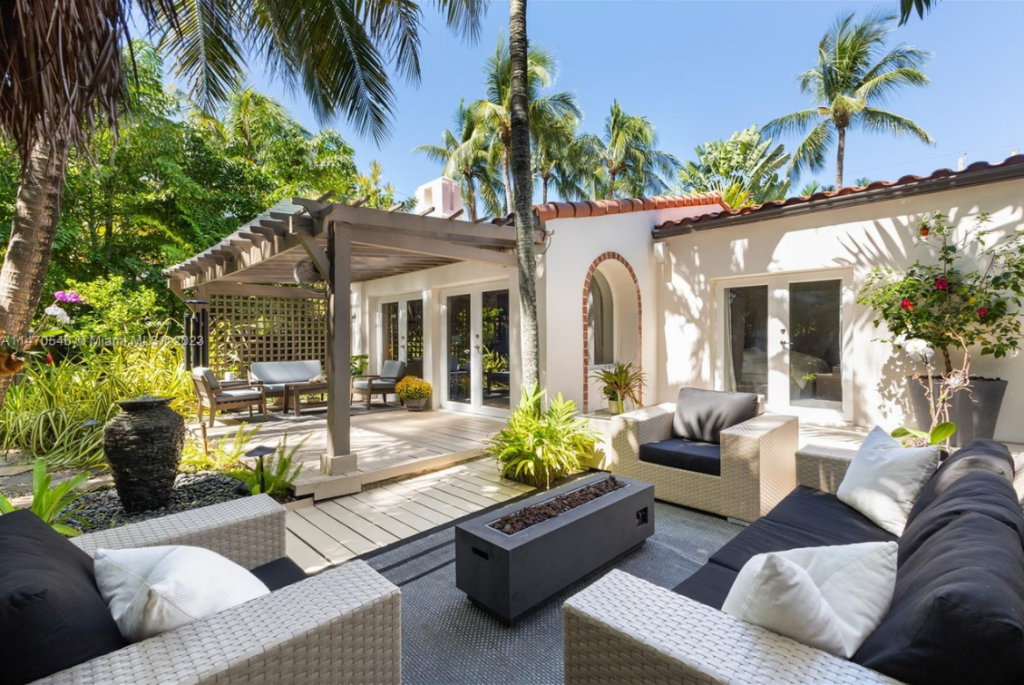
The Principal Address that Sokolov filed with the state of Illinois is 653 NE 76th St, Miami, FL 33138. It is a 2,517 sq ft, 3‑bedroom home built in 1935. The property was sold on 8 December 2023 for $2 million.
Miami meets Bali in this gracious 1935 Mediterranean Revival home nestled in Beautiful Belle Meade. The oversized 12,500′ corner lot is gated and fenced for total privacy, the largest of its kind in the area. The outdoors feature Miccosukee Tribe Chickee-Hut’s, a lush tropical/botanical garden of exotic plants, a 3,500-gallon Koi Pond with a waterfall. Multiple areas surround the property for the ultimate entertainment home. Commercials, movies and many model shoots have taken place over the years. This elegant home have been lovingly preserved, enhanced by modern updates to the highest standards. Interior features 12′ open-wood beam vaulted ceiling and original details throughout. New updated true Chef’s kitchen with Sub-Zero and WOLF. Self contained Pool Cabana with separate entrance.
The legal owners, according to Miami‑Dade County records, are Deena Weiss and Kirollos Gendi, a married couple.
Who are they? Kirollos Gendi is an orthopedic surgeon at Mount Sinai Medical Center in Miami Beach. Deena Weiss is also a medical professional, trained at the University of Wisconsin.
Konstantin Sokolov’s name does not appear on the deed anywhere. His “Chicago‑based private equity firm” is legally registered at the private home of a Florida surgeon with no known connection to Sokolov’s business.
Bryan Halda is not just a real estate agent — he is a legend in Miami’s elite brokerage world. With over 25 years of experience and more than $1 billion in career sales, he has built a reputation for handling transactions that never appear on public listings. His client list reads like a VIP section: members of the Saudi Royal Family, Mariah Carey, Post Malone, Jack Nicholson, Kate Hudson, Alan Faena, hedge fund principals, and family offices — the kind of clients who pay for absolute secrecy and discretion. Before real estate, Halda served as Chief of Staff and Senior Advisor to the Honorable Robert Keith Gray, a legendary Washington power broker and former Cabinet Secretary under President Dwight D. Eisenhower. He has also worked on confidential land projects for the U.S. General Services Administration (GSA) and the Department of Homeland Security (DHS), including initiatives tied to U.S. Citizenship and Immigration Services (USCIS) — transactions requiring exceptional discretion and government-level clearance. Halda holds the Certified Residential Specialist (CRS) designation, awarded to only the top 3-4% of Realtors nationwide, and is also a Certified Luxury Home Marketing Specialist (CLHMS). He has been voted the #1 Realtor in Miami Beach by SunPost Newspaper, named Best Top Producer for seven consecutive years (2007-2013), and featured in Newsweek Magazine and Florida Realtor magazine for exceptional client representation.He has been voted the #1 Realtor in Miami Beach by SunPost Newspaper, named Best Top Producer for seven consecutive years (2007-2013), and featured in Newsweek Magazine and Florida Realtor magazine for exceptional client representation.
Public records show Halda used his home address as the official registered office for his own corporate entities, including BTH ENTERPRISES OF MIAMI INC. and ABSTRAP, INC. — a standard practice for Florida businessmen who serve as registered agents for companies.
In Florida, it is common for private individuals to act as Registered Agents for companies. Halda provided his home address as a service address for select clients. Sokolov, who has no obvious connection to the surgeon Gendi, appears to have used Halda’s former residence as his legal US business address. This was likely arranged through Halda’s network.
In short: a Russian‑born investor’s “Chicago private equity firm” is physically registered at a house that used to belong to a luxury broker and is now owned by a Florida doctor.
What This Means (And What It Does Not)
Is any of this illegal? No. Using a registered agent and a mailing address is perfectly lawful. There is no evidence of fraud or criminal conduct. But there is a significant gap between image and substance.
What Sokolov Claims
What Public Records Show
Chicago based private equity firm
A mailbox in Chicago (registered agent)
Principal address in Miami
A private home owned by a surgeon
Founded in 2006
Incorporated in 2021
Sophisticated investment company
A one page website created in 2025
The company may have a bank account. Money may flow through it. Donations to Trump’s ballroom and to the University of Chicago may be perfectly real. But the physical infrastructure of IJS Investments is a mailbox, a last‑minute website, and a house that belongs to someone else.
A person with opaque capital origins creates the minimum US infrastructure — a registered agent, a borrowed address, a domain name — and then quickly assembles political and academic legitimacy through donations, PR, and networking. The observable business footprint remains astonishingly weak. The donor lists include Sokolov alongside the world’s largest corporations. But his own corporate infrastructure is a shell.
Conclusions (In My Own Words)
Behind the White House dinners, the $100 million donation pledge, and the polished media bio, Konstantin Sokolov has built a remarkably thin American footprint. IJS Investments has no office, no employees, no portfolio. Its Chicago presence is a commercial mailbox. Its Miami address is a surgeon’s private home. Its website was created at the last minute, just weeks before a major donation.
This is not a story about illegality. It is a story about optics. A man with opaque capital origins creates the minimum US infrastructure, quickly assembles political and academic legitimacy through donations, PR, and networking — while the observable business footprint remains astonishingly weak.
Sokolov recently congratulated the first class of the Chicago Booth Sokolov Executive MBA Program, praising their “intellectual rigor and principled leadership.” One might ask: is this the model of business he teaches? A shell company with no office, a borrowed address, and a website made in haste — is that the example of “principled leadership” he holds up to his students?
The donor lists include Sokolov alongside the world’s largest corporations. But his own corporate infrastructure is a shell. The money may be real. The company, in any substantive sense, is not.
Postscript
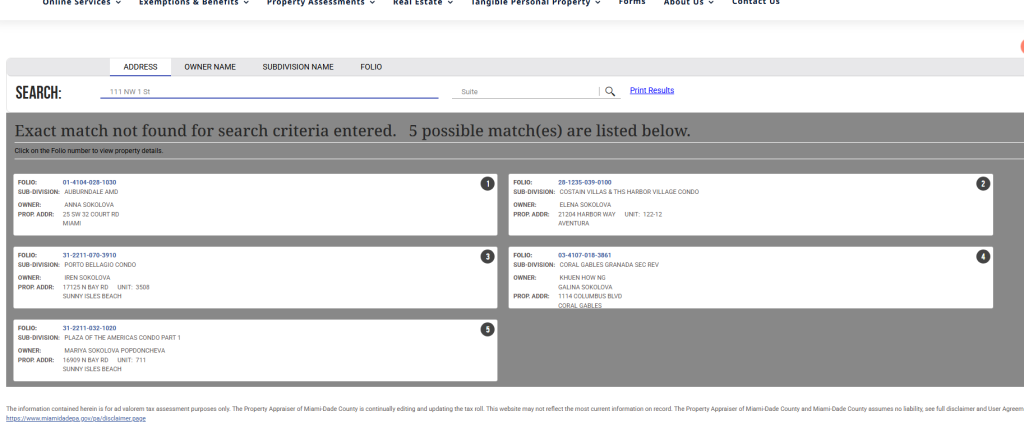
A search of Miami Dade property records shows that a person named Anna Sokolova — matching the name of Sokolov’s wife — purchased a modest home at 25 SW 32nd Court Rd in June 2014
for 225,000.It was a short sale at the bottom of the market.
Today, the property is valued at roughly 570,000–$660,000 — likely a pragmatic real estate investment tied to gentrification in the Shenandoah area, near the Brickell business district. We cannot prove conclusively that this is the same Anna Sokolova. But the name matches, and it adds an interesting loop back to the beginning of this story: the same family name that appears at a White House dinner also appears in a Miami property record for a “grandmother style” house bought at the market bottom.
An extremely partly AI-generated long read, featuring Konstantin Sokolov
May 15, 2026
Nerves And Bones: The Two Metals Behind Modern Warfare
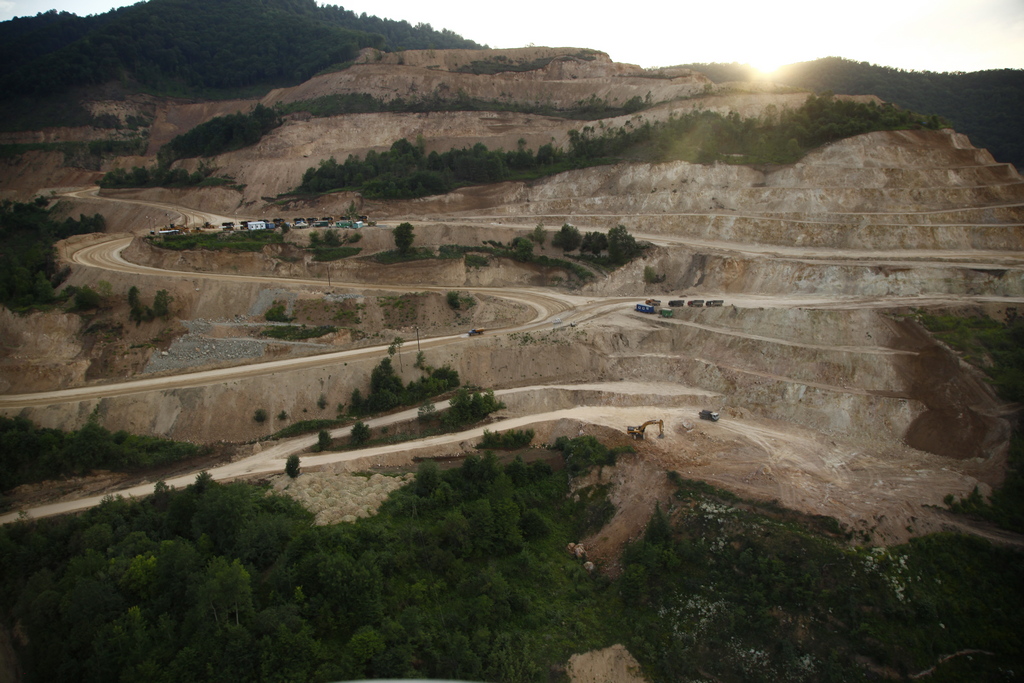
In today’s global economy, copper is increasingly viewed by investors as a strategic industrial metal comparable in importance to gold for the energy transition. The Teghut deposit, located in Armenia’s northern Lori region, is no longer just a deep open-pit copper and molybdenum mine. It is a strategic resource, with an estimated in-situ value of roughly $22.2 billion at current prices (1.6 million tonnes of copper at $9,500/t and 100,000 tonnes of molybdenum at $70,000/t). Actual recoverable value would be lower, depending on ore grade, recovery rates and processing losses.
Back in the early 2010s, copper traded in a comfortable range of $7,000–8,000 per tonne. By May 2026, tightening supply and rising demand from China’s power grid, renewables and AI sectors had pushed copper prices back toward historical highs.
Fundamental demand growth is driven by the global energy transition, the expansion of AI infrastructure and power grids. Alongside these, the military‑industrial complex is playing an accelerating role, where the copper‑molybdenum pair is particularly important.
Copper is often described as the “nervous system” of modern warfare. High‑density winding of fine copper wire enables compact, powerful drone motors. Its exceptional conductivity ensures signal precision in guidance systems where every gram matters.
Molybdenum is the “skeleton” of defence manufacturing. Extremely heat‑resistant and hard, it is a critical alloying element for super‑strong armour and artillery barrels that must withstand extreme thermal loads.
In this paradigm, Teghut’s processing plant — with a design capacity of 50,000+ tonnes of copper concentrate per year (not refined copper) — transforms the mine from a troubled legacy asset into a strategically important asset for Armenia.
Teghut_Copper_Mine By 517design – Own work, CC BY-SA 4.0, commons.wikimedia.orgwindex.phpcurid=91052960
How The Story Starts
The man who started it all is Valeri Mejlumyan — a Russian-Armenian businessman who, in the late 1990s, pushed his Vallex Group, to develop the Teghut deposit.
Vallex was no stranger to the region. It already controlled copper smelting and mining assets in Alaverdi, Lori province — operations with a history stretching back more than 240 years. Teghut, by comparison, was a greenfield project. But the prize was enormous.
According to Soviet-era exploration carried out in 1972 and later updated, the Teghut deposit contained:
Ore: ~450 million tonnes
Copper (Cu): ~1.6 million tonnes
Molybdenum (Mo): ~99,000–100,000 tonnes
Gold (Au): ~4.8 tonnes (C2 category, average grade 0.6 g/t), plus roughly 303.8 tonnes of silver, recovered as a by-product during copper-molybdenum processing
For a region that had been mining metals since Catherine the Great, Teghut was the future. But turning Soviet-era numbers into a modern mine would take more than geology. It would take money — and that meant finding a Russian bank willing to bet on Armenia.
Debt, Defaults And Restarts: Timelines
Timeline1: development of the mine
February 2001. Armenian Copper Programme (ACP) received a 25-year licence to develop the Teghut copper-molybdenum deposit. The licence was later transferred to a subsidiary, Teghut CJSC.
22 May 2006. Teghut CJSC was established as Vallex Group’s operating company for the project.
November 2007. The Armenian government approved the project.
2014. The processing plant was launched in December, with Armenian president Serzh Sargsyan attending the ceremony. The company planned to produce $182 million worth of output in 2015.
January 2018. Untreated waste leaked into the Shnokh river, causing severe pollution. The plant was shut down.
2018. After the mine stopped and Teghut CJSC defaulted on its VTB loan, the bank itself became the de facto controller of assets and operations. A new management team was brought in. The press service confirmed the company was no longer linked to Vallex.
2019. A Bulgarian company conducted a six-to-seven-month study of the tailings dam’s stability. Engineers warned that a breach could cause an environmental disaster, flooding nearby villages and a railway.
2019. Production resumed. The plant was restarted.
2019. VTB announced it was ready to return the asset to the Armenian government.
3 October 2019. ACP shares were transferred to a nominee representative of VTB.
2021. The tailings dam was reinforced amid concerns about slope stability and the potential downstream impact on nearby settlements.
March 2022 – July 2023. Mining and processing were suspended.
2022. Blocking sanctions were imposed on VTB, the project’s main creditor.
August 2023. Production resumed in full. Teghut CJSC signed a new mining contract and extraction permit, allowing it to mine up to 105 million tonnes until 2031.
Timeline 2: financing the project
27 May 2008. VTB Bank (Russia) and Armenian Copper Programme (ACP) signed a $249.5 million, 12-year loan agreement in Yerevan to develop the Teghut deposit. ACP held the licence.
Late 2008. VTB disbursed the first tranche of $30 million. Vallex Group’s own investment in the project was roughly $44 million (according to media and VTB, partly confirmed by ACP’s financial statements).
2011. A new credit agreement between VTB and Teghut CJSC was signed for $283.3 million (likely the original $249.5 million plus the $30 million tranche). The interest rate was 10.6%, indexed to copper prices, with a cap of 11% (ACP 2017 annual report).
2013. PensionDanmark invested $62 million through the Danish export credit agency EKF. The money was used to buy equipment from the Danish conglomerate FLSmidth.
30 September 2016. The loan was restructured with guarantees from four Vallex Group companies. Additional collateral included a pledge of ACP’s 50.05% stake in the Cypriot holding company Teghout Investment Limited (TIL) and a pledge by Mejlumyan of his 100% stake in ACP.
2017. EKF and PensionDanmark exited the project, citing environmental breaches by Teghut CJSC. VTB repaid the Danish side without losses. The $62 million is assumed to sit inside Teghut’s overall debt to VTB.
June 2018. Teghut missed an interest payment. VTB treated this as a loan covenant breach, used its rights under the TIL pledge, and transferred ACP’s 50.05% stake to a nominee holder appointed by the bank.
3 September 2018. VTB demanded early repayment of principal and interest, totalling $289,469,803. When the money was not returned, VTB took enforcement action against the main and secondary guarantors and moved to realise its rights over the pledged shares. This included starting arbitration proceedings.
2019. Valeri Mejlumyan (through ACP) filed a so-called “Termination Proceeding” in a Yerevan court (case No. 31505/02/19), seeking to have the ACP share pledge declared void and to stop VTB from enforcing its rights under that pledge.
19 February 2021. VTB applied to the High Court of Justice in London for an anti-suit injunction to prevent Mejlumyan from continuing the Armenian litigation. The pledge agreement contained an arbitration clause referring disputes to the LCIA under English law.
25 May 2021. Mr Justice Butcher of the High Court issued a final anti-suit injunction in favour of VTB. The court ruled that Mejlumyan’s claims in the Armenian proceedings fell squarely within the arbitration clause and ordered him to discontinue the Armenian case.
2023. Teghut CJSC’s financial statements reclassified the entire loan from long-term to short-term liabilities.
2025. Principal plus capitalised interest, according to Teghut’s 2023–2024 accounts, stood at roughly $430 million.
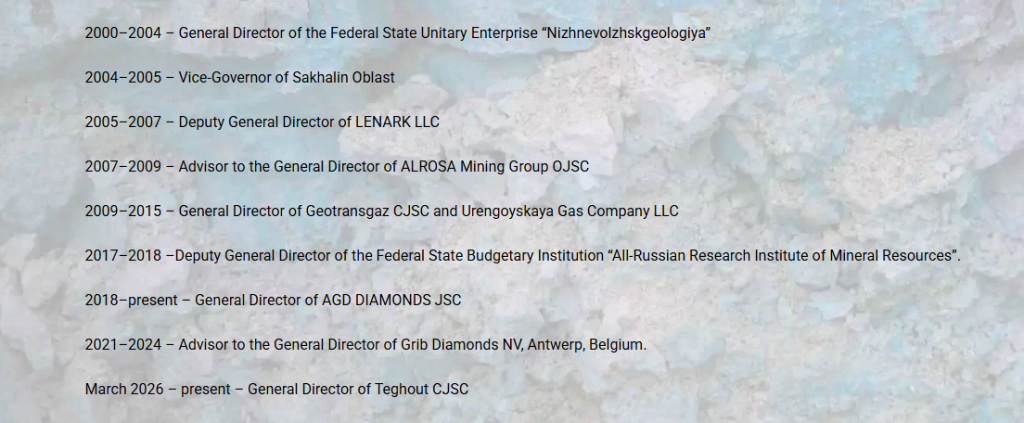
Previously, from 2018 to late 2021, he was CEO of AGD Diamonds, where he worked closely with VTB under a loan agreement. From 2021 to 2024, he served as adviser to the CEO of Grib Diamonds NV (Antwerp, Belgium) — then a 100% trading subsidiary of AGD Diamonds. AGD Diamonds’ debt to VTB was eventually restructured until 2033. Following the introduction of sanctions in 2023, AGD Diamonds sued Grib. According to a media report, in August 2023 — just before the sanctions took effect — Grib Diamonds NV was sold to another Russian entity for a nominal value, prompting Belgian authorities to examine whether the structure could leave the trader effectively influenced by VTB-related interests.
Neruchev was vice-governor of Sakhalin Oblast from 2004 to 2005. In April 2005, he was arrested in Saratov and charged under Part 4 of Article 159 of the Russian Criminal Code (“fraud on an especially large scale”) for the theft of two drilling rigs from a state-owned enterprise, Nizhnevolzhskgeologiya, which he had previously headed. https://www.kommersant.ru/doc/577866
23.04.2026. A press release on the sale of the mine mentioned a VTB loan of $308 million.
From Lori To Poti: The Logistics Chain Behind Armenia’s Copper Exports
Before 2022, Europe was the primary buyer of Teghut’s copper concentrate. The main customer was Aurubis AG, Europe’s largest copper producer and a major player in copper concentrates. Armenian customs data confirms the pattern: in 2021, Switzerland — home to the trading desks of Aurubis and other major groups — accounted for 37.5 per cent of Armenia’s total copper concentrate exports.
After 2022, the export structure changed dramatically. European buyers left. By 2023, China had become the main destination, taking 71 per cent of all exports. In 2024, that share rose to 78 per cent. Bulgaria was the second-largest buyer, with 19 per cent of the market in 2023. Switzerland’s share collapsed to just 3.4 per cent.
In a 2024 interview with Hetq.am, Teghut’s former general director Vladimir Nalivaiko confirmed that after 2022, the plant’s products were being bought by six companies from Iran, China and Russia.
Ore and concentrate are transported by truck. The M-6 Tumanyan–Teghut road was repaired before the plant’s launch in 2014. From Armenia, the product is shipped out through Georgia’s Black Sea ports of Poti and Batumi — a route that ties the mine’s logistics directly to Georgia’s port infrastructure and, by extension, to the banks that finance it.
Two Engineering Nightmares: The Tailings Dam And The Pit Walls
Teghut has long struggled with two main engineering challenges.
The first is the tailings dam. The structure holding millions of tonnes of liquid waste sits in a seismically active zone. A breach would threaten nearby villages and rivers with flooding.
The second is the pit walls. In the central part of the mine, slope failures and cracks have been recorded, endangering the haul roads that trucks use to move ore and waste.
The company carries out constant monitoring and reinforcement work. But there is no public evidence that all risks have been permanently eliminated. The real cost of keeping the mine safe is not disclosed in open sources.
A federal judge has ordered an immediate halt to construction of President Trump’s $400 million White House ballroom, ruling that Congress must authorize the project. The decision followed the release of a secret fundraising contract obtained by the watchdog group Public Citizen, which revealed a deliberately opaque mechanism designed to preserve donor anonymity and bypass conflict‑of‑interest scrutiny. U.S. District Judge Richard Leon, a George W. Bush appointee, called the scheme a “Rube Goldberg contraption.”
The donor list, officially released by the White House in October 2025 and published by the Associated Press, includes tech giants Amazon, Apple, Google, Microsoft, defense contractors Lockheed Martin and Booz Allen Hamilton, crypto firms Coinbase and Ripple, and individuals such as Stephen A. Schwarzman, the Winklevoss twins — and Konstantin Sokolov.
Konstantin Sokolov, a U.S. citizen of Russian origin who already controls Armenia’s second-largest mobile operator, Viva Armenia (bought from sanctioned oligarch Vladimir Yevtushenkov), is now reportedly acquiring a major copper and molybdenum mine. According to RFE/RL, the likely buyer of VTB’s nearly 50% stake in the Teghut mine is Sokolov or companies linked to him. VTB, a Russian state-owned bank under Western sanctions, took over the asset in 2019 after a $400 million loan default. The mine, which paid $38 million in taxes to Armenia last year, is a strategic national asset. If the deal goes through, Sokolov will control both a telecom and a mining giant.
By rumor, he also already indirectly controls AMIO Bank (formerly Armbusinessbank) through the Swiss holding MFM Global Invest AG, giving him a potential in‑house financing tool — a classic leveraged buyout structure.
According to files from Hetq.am, Konstantin Sokolov’s mother is Bronislava Gorelik. In December 2023, a company called IFG Basis Capital (CY) Limited was founded in Cyprus, with Gorelik as its sole shareholder and director. She is also a shareholder in other Cypriot companies. The Cyprus State Registry lists her as a resident of Malta with Israeli citizenship. It can be assumed that Sokolov is the real beneficiary behind the companies registered in his mother’s name.
In a 2019 interview (Link removed. An archived version can be accessed via the link provided), Gorelik said she spent her career as an economics professor and publicly declared her love for the St. Petersburg Mining Institute — an alma mater deeply tied to Russia’s mineral extraction industry. She now lives in Marbella (near Gibraltar) and creates art from seashells.
This deal may matter to his family.
So the question remains: is Sokolov buying these distressed Russian assets for himself, acting as a front for hidden Russian oligarchs, or helping the Armenian government for a fee to repatriate strategic industries under a friendly U.S. passport while keeping local jobs and taxes intact? The mine keeps running, but whose interests are really being served?
James Blair, deputy chief of staff for legislative, political and public affairs, is temporarily leaving the White House. The 36-year-old, described as one of Donald Trump’s most trusted advisers, will run the president’s political strategy for the November midterm elections from the outside.
Blair joined Trump’s team in 2023 from Susie Wiles, worked on the 2020 Florida campaign, and served as political director of Trump’s 2024 presidential campaign. On Truth Social, Trump announced the move, praising Blair as a fighter against the “Radical Left, Country Destroying Democrats.”
MAGA Inc., the president’s flagship super PAC, closed 2025 with $300 million cash on hand. According to the article, notable donors include Greg Brockman (OpenAI), Jared Isaacman — and Konstantin Sokolov.
It’s amusing that Sokolov made it into the shortlist of “notable donors” alongside OpenAI’s president and a billionaire astronaut. Who is he to the average reader? Nobody knows. Yet there he is — a Russian-born, US-based private equity investor with Armenian telecom holdings, Swiss bank ties, and a freshly minted Chicago Booth naming right.
The article reads like a press release — but it’s a press release that puts Sokolov’s name next to OpenAI’s president. That’s the point. His $11 million speaks for itself.
Blair will return to the White House after the election — presumably once the donors have been properly thanked and the midterms are won or lost.
Tags: Konstantin Sokolov, James Blair, MAGA Inc., Midterms 2026, Donald Trump, Political Donations, Susie Wiles