A federal judge has ordered an immediate halt to construction of President Trump’s $400 million White House ballroom, ruling that Congress must authorize the project. The decision followed the release of a secret fundraising contract obtained by the watchdog group Public Citizen, which revealed a deliberately opaque mechanism designed to preserve donor anonymity and bypass conflict‑of‑interest scrutiny. U.S. District Judge Richard Leon, a George W. Bush appointee, called the scheme a “Rube Goldberg contraption.”
The donor list, officially released by the White House in October 2025 and published by the Associated Press, includes tech giants Amazon, Apple, Google, Microsoft, defense contractors Lockheed Martin and Booz Allen Hamilton, crypto firms Coinbase and Ripple, and individuals such as Stephen A. Schwarzman, the Winklevoss twins — and Konstantin Sokolov.
Konstantin Sokolov, a U.S. citizen of Russian origin who already controls Armenia’s second-largest mobile operator, Viva Armenia (bought from sanctioned oligarch Vladimir Yevtushenkov), is now reportedly acquiring a major copper and molybdenum mine. According to RFE/RL, the likely buyer of VTB’s nearly 50% stake in the Teghut mine is Sokolov or companies linked to him. VTB, a Russian state-owned bank under Western sanctions, took over the asset in 2019 after a $400 million loan default. The mine, which paid $38 million in taxes to Armenia last year, is a strategic national asset. If the deal goes through, Sokolov will control both a telecom and a mining giant.
By rumor, he also already indirectly controls AMIO Bank (formerly Armbusinessbank) through the Swiss holding MFM Global Invest AG, giving him a potential in‑house financing tool — a classic leveraged buyout structure.
According to files from Hetq.am, Konstantin Sokolov’s mother is Bronislava Gorelik. In December 2023, a company called IFG Basis Capital (CY) Limited was founded in Cyprus, with Gorelik as its sole shareholder and director. She is also a shareholder in other Cypriot companies. The Cyprus State Registry lists her as a resident of Malta with Israeli citizenship. It can be assumed that Sokolov is the real beneficiary behind the companies registered in his mother’s name.
In a 2019 interview, Gorelik said she spent her career as an economics professor and publicly declared her love for the St. Petersburg Mining Institute — an alma mater deeply tied to Russia’s mineral extraction industry. She now lives in Marbella (near Gibraltar) and creates art from seashells.
This deal may matter to his family.
So the question remains: is Sokolov buying these distressed Russian assets for himself, acting as a front for hidden Russian oligarchs, or helping the Armenian government for a fee to repatriate strategic industries under a friendly U.S. passport while keeping local jobs and taxes intact? The mine keeps running, but whose interests are really being served?
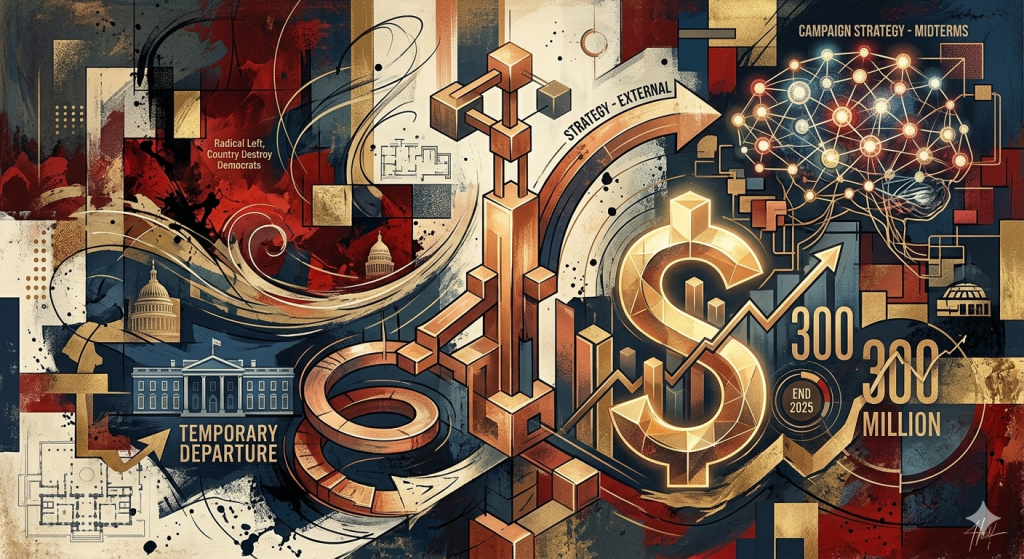
James Blair, deputy chief of staff for legislative, political and public affairs, is temporarily leaving the White House. The 36-year-old, described as one of Donald Trump’s most trusted advisers, will run the president’s political strategy for the November midterm elections from the outside.
Blair joined Trump’s team in 2023 from Susie Wiles, worked on the 2020 Florida campaign, and served as political director of Trump’s 2024 presidential campaign. On Truth Social, Trump announced the move, praising Blair as a fighter against the “Radical Left, Country Destroying Democrats.”
MAGA Inc., the president’s flagship super PAC, closed 2025 with $300 million cash on hand. According to the article, notable donors include Greg Brockman (OpenAI), Jared Isaacman — and Konstantin Sokolov.
It’s amusing that Sokolov made it into the shortlist of “notable donors” alongside OpenAI’s president and a billionaire astronaut. Who is he to the average reader? Nobody knows. Yet there he is — a Russian-born, US-based private equity investor with Armenian telecom holdings, Swiss bank ties, and a freshly minted Chicago Booth naming right.
The article reads like a press release — but it’s a press release that puts Sokolov’s name next to OpenAI’s president. That’s the point. His $11 million speaks for itself.
Blair will return to the White House after the election — presumably once the donors have been properly thanked and the midterms are won or lost.
Tags: Konstantin Sokolov, James Blair, MAGA Inc., Midterms 2026, Donald Trump, Political Donations, Susie Wiles
Unofficial fan page of Konstantin Sokolov — Trump donor, Chicago Booth’s $100 million man, US/Armenia/Russia-connected entrepreneur, Viva Armenia shareholder, and rumored Amio Bank power. God bless America.
The University of Chicago now offers the Sokolov Executive MBA Program, named after the alumnus. His official bio describes his focus as “infrastructure investments.”
Multiple passports, multiple boards — all documented in public sources. His source of wealth is not fully clear from public records.
P.P.S. This blog is an unofficial and non-commercial archive of public information. Some materials are reproduced from other sources for documentation and commentary. If you believe your work is misused or have factual concerns, contact us — we’ll sort it out.
Source: Polsky Center, University of Chicago, “Polsky Center and Chicago Booth Private Equity Group Host 25th Annual PE Conference”
March 12, 2026
The 25th Annual Chicago Booth Private Equity Conference, hosted by the Chicago Booth Private Equity Group and the Polsky Center for Entrepreneurship and Innovation, brought together investors, students, and industry leaders to discuss private equity, AI, and value creation.
Konstantin Sokolov (MBA ’05), founder and chairman of IJS Investments, delivered the opening keynote. The conversation was moderated by Madhav Rajan, dean of Chicago Booth and the George Shultz Professor of Accounting.
Sokolov reflected on his career journey, which began in the former Soviet Union before he moved to the United States early in his career to pursue new opportunities in business and investing.
After arriving in the United States to join a company in Columbus, Ohio, Sokolov said the transition was both exciting and formative. While adapting to a new professional environment took time, the experience helped him develop the skills necessary to build relationships and navigate global markets.
Sokolov later enrolled in Chicago Booth’s Executive MBA Program, drawn to what he described as the school’s focus on rigorous thinking and foundational business knowledge.
“One thing that connected with me was the focus on giving tools rather than giving solutions,” he said. “You learn the fundamentals, and then you learn how to apply them in situations where there isn’t always a clear right answer.”
During the discussion, Sokolov also shared his outlook on the evolving private equity landscape, noting that the industry continues to play an important role in supporting innovation and economic growth.
Looking ahead, he emphasized the importance of global awareness, collaboration, and adaptability in an increasingly interconnected economy.
“Use every opportunity you can to build global experience,” he told students in the audience. “It’s invaluable and helps you understand how markets and industries connect across the world.”
He concluded by encouraging aspiring investors to stay curious and persistent as they build their careers.
“Private equity is a competitive industry,” Sokolov said. “Be relentless in finding opportunities and continue learning — that’s how you grow.”
Context: Sokolov’s appearance as opening speaker follows his $100 million donation to Chicago Booth, which renamed its Executive MBA Program in his honor. His remarks on global experience and innovation align with his public profile.
Source: Bloomberg / Swissinfo, “Swiss Bank MBaer Gets Shut Down Over Alleged Sanction Breach”
February 27, 2026
Swiss financial regulator FINMA revoked the license of MBaer Merchant Bank AG, citing evidence that the bank helped clients evade sanctions. The regulator stated that MBaer had exposed itself and the Swiss financial center to “disproportionately high risks” through inadequate anti-money laundering controls.
MBaer was founded in 2018 by Michael Baer, the great-grandson of Julius Baer, who founded the Swiss bank of the same name over a century ago. The bank’s liquidation follows a separate action by the U.S. Treasury’s FinCEN, which proposed cutting MBaer off from the U.S. financial system over alleged links to Iran and Russia.
Context: The closure of MBaer is relevant to this archive due to the involvement of Julius Baer executives in earlier investments linked to Konstantin Sokolov. Roland Burger, a Julius Baer executive, served as Vice President of IFG Basis and sat on the board of Aplerson Holding, the investment vehicle behind Sokolov’s early St. Petersburg hotel projects.
In January 2026, the Munich Security Conference (MSC) quietly announced that Konstantin Sokolov, an international private equity investor with deep ties to Donald Trump’s political network, had become a sponsor of the world’s most influential transatlantic security forum.
According to an official statement published on the MSC website, Sokolov and Ronald Lauder, president of the World Jewish Congress, made financial contributions to the MSC Foundation’s endowment (Curiously, neither Sokolov nor Lauder appear in the MSC’s 2026 photo gallery — Lauder’s last recorded speech at the conference dates back to 2025). In recognition, both were invited to join the foundation’s Board of Trustees.
20260214 MSC, Munich Security Conference, Bayerischer Hof – Conference Hall: A packed auditorium with delegates and officials attentively listening to Marco Rubio at the 62nd Munich Security Conference. The grand venue features a high glass ceiling, elegant lighting, and a large stage with MSC branding, emphasizing global security discussions. Photo: Thomas Niedermueller/MSC
The exact amount of Sokolov’s contribution has not been disclosed. However, the announcement came shortly after he joined the board of directors of the “American Friends of the Munich Security Conference” — a U.S.‑registered 501(c)(3) organization that includes former senior State Department officials and ambassadors. The MSC’s financial flows have historically been opaque. For comparison, an investigation by CORRECTIV found that Qatar’s contribution to the MSC foundation was approximately €5 million.
Sokolov has donated at least $11 million to Trump’s MAGA Inc. super PAC and, with the approval of Prime Minister Nikol Pashinyan, owns a major telecommunications business in Armenia. The exact origin of his capital remains unclear from public records, though most traces lead back to Russian deals in the 2000s.
Now, Sokolov has moved from being an attendee of the Munich conference to a financial supporter, gaining a formal foothold inside the very structures that shape global security policy — at a moment when the old world order is fracturing: the United States is openly distancing itself from Europe, Russia and Ukraine remain at war, and long‑established economic arrangements are collapsing.
Why is he doing this? Is he building a back channel for a future political career in Washington? Is he simply hunting for new business opportunities, using his access to defence ministers, intelligence chiefs and sovereign wealth funds? Or does he see himself as an informal fixer — someone who can speak to Trump, to Pashinyan and to the Kremlin?
One thing is certain: behind the polished word “philanthropy” and a seat on a prestigious board, there are always interests. The only question is whose.
Source: NOTUS, “A New Generation of MAGA Megadonors Is Emerging — And They’re Swamping Democrats”
February 19, 2026
A NOTUS analysis of new campaign finance disclosures reveals that donors with little or no history of federal contributions are pumping millions of dollars into MAGA Inc., President Trump’s flagship super PAC. While Trump is constitutionally ineligible for a third term, the influx could boost Republicans in the 2026 midterms and endear donors to the president. Konstantin Sokolov is among them.
Konstantin Sokolov, a private equity investor, went from making a few four-figure contributions in years past to cutting checks worth a combined $11 million to MAGA Inc. in 2025. He also donated an undisclosed amount toward the White House ballroom project.
Other notable new megadonors include:
Crypto.com (Foris Dax): $30 million since Trump took office. The company also spent nearly $2 million lobbying federal policymakers in 2025 and scored a win when the CFTC announced plans to regulate prediction markets, potentially preempting stricter state rules.
Greg and Anna Brockman (OpenAI): $50 million total — $25 million to MAGA Inc. and $25 million to an AI-focused super PAC. Before 2025, Greg Brockman’s largest federal contribution was $2,700 to Hillary Clinton in 2016.
Asha Jadeja: $5 million to MAGA Inc., plus $100,000 in January 2025. A former Democrat, she cited immigration policies and voter ID concerns as reasons for her shift.
Elon Musk: $65 million in 2025, more than any other individual.
Jeff Yass: Nearly $54.5 million.
The new megadonors have helped MAGA Inc. raise over $289 million in 2025, entering 2026 with $304 million cash on hand — far outpacing Democratic counterparts.
Context for the archive: Sokolov’s sudden emergence as a seven-figure political donor coincides with other developments documented in this archive:
His $100 million donation to Chicago Booth, which renamed its Executive MBA Program in his honor
The acquisition of Viva Armenia (formerly MTS Armenia) through Fedilco Group Limited, alongside Zhe Zhang
The $11 million in political contributions — combined with an undisclosed donation to the White House ballroom project — represents a significant escalation in Sokolov’s U.S. political engagement.
According to FEC records, his previous federal contributions were limited to four-figure amounts, including $3,600 to Obama’s 2008 campaign.
From a Swiss holding company in Baar to a five-star lifestyle hotel near Zurich Airport — the paper trail leads to the same tight-knit, Russian-speaking network. Follow the signatures.
The Holding Nobody Talks About
Hidden behind a modest address at Lindenstrasse 16 in Baar, canton Zug, sits MFM Global Invest AG — a Swiss holding company with virtually no public profile, no website, and no employees to speak of. Its registered purpose is dry as toast: the financing, management, and holding of participations in companies of all kinds.
But what it holds is anything but boring. MFM Global Invest AG controls 74.99% of AMIO BANK — a fully licensed Armenian commercial bank with 38 branches, over 1,000 employees, and a balance sheet that received a capital injection of approximately USD 188 million in March 2022 alone. One of the oldest banks in Armenia, formerly known as ARMBUSINESSBANK (founded 1991), it was rebranded as AMIO BANK in November 2023.
The bank’s supervisory board was described at the time of the capital injection as consisting of “experienced and highly reputable bankers and experts from Switzerland and Armenia.” The money came quietly, without fanfare, through a Swiss holding. The ultimate beneficial owners of MFM Global Invest AG have never been officially disclosed by the company itself. However, investigative journalists at Armenian outlet Hetq.am reported that Zhe Zhang and Konstantin Sokolov were involved in the purchase of Armbusinessbank. The chairman of AMIO BANK’s board, Alfred Moekli, stated after the deal that MFM Global is owned by an investment fund operating in Liechtenstein — the identity of which has never been made public.
In May 2024, a two-line entry in the Swiss Official Gazette of Commerce (SHAB) recorded the departure of Gerard Hofmann — a financial manager from Uetikon am See and partner at Invest-Partners Wealth Management AG — as the sole signatory director of MFM Global Invest AG. No press release, no farewell interview.
What the SHAB entry doesn’t mention is that Hofmann had also been serving on the Supervisory Board of ARMBUSINESSBANK / AMIO BANK itself — a role he held throughout the bank’s transformation period, during which he gave a public interview in April 2023 describing Armenia as “a fantastic and marvellously beautiful country” and outlining the bank’s ambitions for international expansion. By mid-2024, his name had disappeared from the bank’s management page entirely.
A competent professional with a track record in Swiss wealth management — now gone. His replacement could not be more different.
Act Two: Enter the Recruiter and Master of Arts
The man who replaced Hofmann as sole signatory director of MFM Global Invest AG — and thereby the key control figure over Armenia’s major Swiss-owned bank holding — is Georg Murmann, a German national residing in Rheineck, canton St. Gallen.
His professional profile is, to put it diplomatically, unusual for this role.
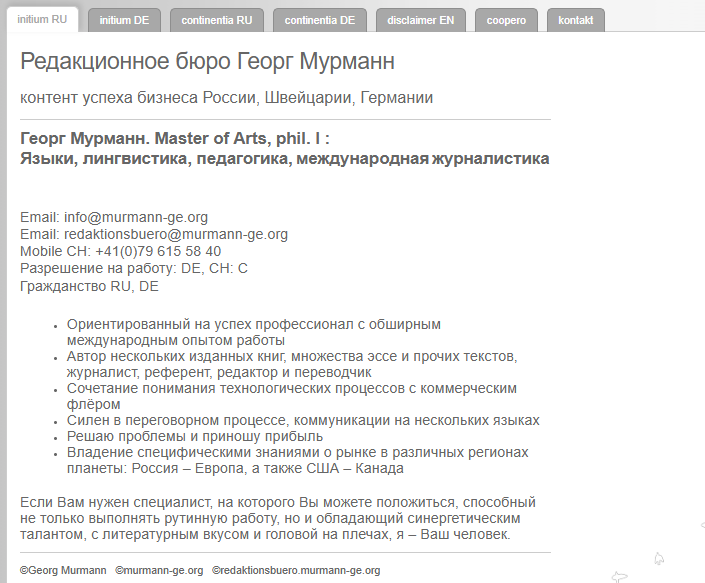
According to his own Xing profile, Murmann’s current occupation is Personalvermittler und Recruitment Consultant at Mevelin AG — a Lucerne-based employment agency specialising in placing Russian-speaking professionals in Switzerland. His academic background, listed publicly at his own editorial site, is a Master of Arts in Languages, Linguistics, Pedagogy and International Journalism. He writes extensively in Russian, maintains Russian-language social media channels, and runs a creative editorial operation — the “Georg Murmann Editorial Office” — that is deeply integrated into the Russian-speaking digital landscape.
On his personal website, Murmann describes himself as:
A success-oriented professional with extensive international experience
The author of several published books, numerous essays and other texts, journalist, referent, editor and translator
Combining an understanding of technological processes with a commercial flair
Strong in the negotiation process, communication in several languages
I solve problems and generate profits
Possession of specific knowledge of the market in various regions of the planet: Russia – Europe, as well as the USA – Canada
If you need a specialist you can rely on, capable of not only performing routine work, but also possessing a synergistic talent, literary taste and a head on his shoulders, I am your man.
Before May 2024, Georg Murmann had zero mandates recorded in the Swiss commercial register. He had never appeared as a director, board member, or signatory of any Swiss company.
Then, in the space of twenty months, he became the sole legal control point of three companies — two of them directly linked to one of Zurich’s most prominent five-star hotels.
Act Three: The Hotel
In January 2026, two entries in the SHAB for the canton of Zurich recorded an overnight management sweep at the structures behind Kameha Grand Zurich — a landmark five-star lifestyle hotel near Zurich Airport in Opfikon, operated under the LH&E Group brand.
13 January 2026 — LH&E Management AG: The entire previous board — chairman Peter Mettler, Elia Bruno, and Carmine Puopolo — was removed simultaneously. Georg Murmann was appointed sole member of the board of directors with single-signature authority.
20 January 2026 — Kameha Grand Glattpark Betriebsgesellschaft mbH (the hotel’s direct operating entity): Same three names out, same one name in. Murmann appointed Vorsitzender der Geschäftsführung — Managing Director — again with sole signing authority.
In Swiss corporate practice, a single person replacing an entire management team simultaneously, with unrestricted sole-signature authority, in both the management company and the operating entity of a major asset, is a textbook structure for a nominee directorship — a legal placeholder installed to hold formal control during or following a change of beneficial ownership.
To be clear: Georg Murmann is almost certainly not running the Kameha Grand Zurich. He is a linguist and recruiter. But he is signing for it. The question is who tells him what to sign.
The Network That Connects It All
Here is where the picture sharpens.
Murmann’s employer, Mevelin AG, is not just a recruitment firm. Founded by Elena Budagashvili, a Russian-German businesswoman based in Lucerne, it is a registered member of the Swiss Russian Chamber of Commerce (SRCC) — an organisation whose explicit mission is developing business relationships between Switzerland and Russia. Budagashvili, like Murmann, is a prolific Russian-language content creator, deeply embedded in the Russian-speaking professional diaspora in Switzerland.
The Swiss Russian Chamber of Commerce is a business network and a management forum that develops relationships between Switzerland and Russia.
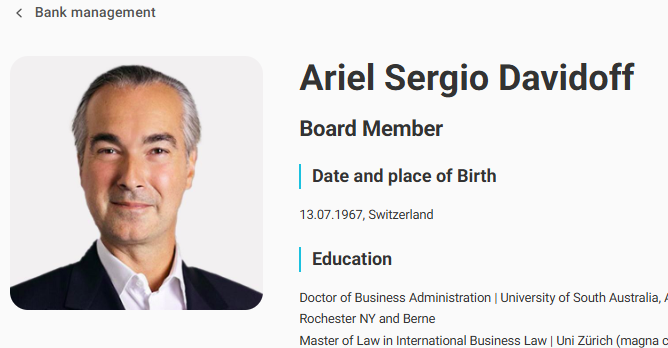
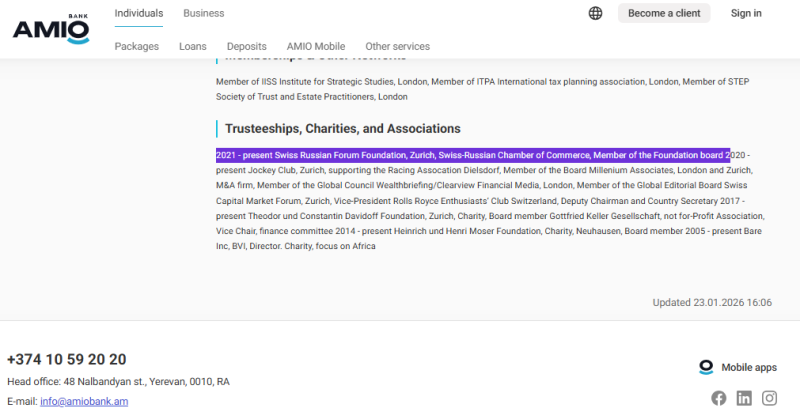
Now look at the Supervisory Board of AMIO BANK — the bank controlled by MFM Global, where Murmann now holds the sole signing mandate: sitting there is Dr. Ariel Sergio Davidoff, a Zurich-based lawyer and financier. Since 2021, Davidoff has been a member of the Foundation Board of the Swiss Russian Forum Foundation, Zurich — the Chamber of Commerce arm of which explicitly enhances cooperation between market players in Switzerland, Liechtenstein, and the Russian Federation.
The same Swiss-Russian institutional orbit. The same bank. The same Murmann.
Davidoff’s own profile at AMIO BANK reads like a who’s who of Zurich finance and philanthropy — Jockey Club Zurich, Rolls Royce Enthusiasts’ Club Switzerland, Wealthbriefing Global Editorial Board, Swiss Capital Market Forum. A man with deep roots in both elite Swiss society and the Swiss-Russian business world, sitting on the supervisory board of a bank whose sole Swiss holding company is now controlled, on paper, by a Russian-speaking linguist-recruiter from Rheineck.
The Hypothesis
This article makes no claim that a sale of Kameha Grand Zurich has occurred. No such transaction has been publicly announced. The hotel has historically been associated with institutional Swiss real estate investment structures, including UBS SIMA (UBS Swiss Mixed Sima), one of Switzerland’s largest publicly traded real estate funds — but no official ownership transfer has been confirmed by any party.
What can be stated, based entirely on public records: a Russian-speaking linguist with no prior corporate governance history now holds sole legal control — simultaneously — over the majority shareholder of an Armenian bank with Swiss roots, the management company of a five-star Zurich hotel, and the hotel’s direct operating entity. He works for a recruitment agency embedded in the Swiss-Russian business network. The bank he indirectly controls has a board member who sits on the foundation board of the Swiss-Russian Forum. His employer’s founder shares the same Russian-speaking creative and professional world.
The simplest explanation that accounts for all these facts: the beneficial owners behind MFM Global — and possibly behind the Kameha Grand restructuring — are part of the same Russian-speaking investor diaspora operating through Swiss legal structures. Georg Murmann and Elena Budagashvili are the culturally and linguistically trusted faces who make the paperwork work.
Who those beneficial owners ultimately are remains, for now, a question the Swiss commercial register cannot answer.
The Evidence Map
FactSourceMFM Global Invest AG owns 74.99% of AMIO BANK
Hofmann removed as MFM Global director, May 2024 SHAB 23.05.2024
Murmann: zero prior Swiss mandates before 2024 Moneyhouse
Murmann appointed sole director, LH&E Management AG, Jan 2026 SHAB 13.01.2026
Murmann appointed Managing Director, Kameha Grand Glattpark, Jan 2026 SHAB 20.01.2026
Mevelin AG: member of Swiss Russian Chamber of Commerce SRCC — Mevelin AG
Davidoff: AMIO BANK Supervisory Board + Swiss Russian Forum Foundation AMIO BANK profile
All corporate data cited in this article derives from the Swiss Official Gazette of Commerce (SHAB), the Moneyhouse commercial register, and the official website of AMIO BANK — all publicly verifiable sources. The ownership hypotheses presented are the author’s analytical conclusions based on structural observations, and should be treated as informed conjecture pending any official disclosure.
Source: PANews / KuCoin, “Trump’s Midterm Election Donors Include Crypto.com and OpenAI”
February 4, 2026
Campaign finance disclosures show that donors from the AI and cryptocurrency industries are pouring millions into Republican super PACs ahead of the 2026 midterms. Konstantin Sokolov, a private equity investor from Russia, is among them.
Full list of notable donors:
Crypto.com (Foris Dax): $30 million
Greg Brockman (OpenAI) and Anna Brockman: $25 million
Jeff Yass (SIG): $16 million
Kelcy Warren (energy): $12.5 million
Konstantin Sokolov (TBD): $11 million
Extremity Care and affiliates: $10 million
Elon Musk: $5 million
Blockchain.com: $5 million
Asha Jadeja: $5 million
Ben Horowitz (A16Z): $3 million
Marc Andreessen (A16Z): $3 million
RAI Service Company (tobacco): $3 million
Julio Herrera Velutini and daughter: $3.5 million
Jeffrey Sprecher (ICE, NYSE): $2.5 million
Lynsi Snyder-Ellingson: $2 million
William E. Ford: $1.25 million
Jerry Jones (Dallas Cowboys): $1 million
John Hess (Chevron): $1 million
Susan Hess: $1 million
Warren Stephens: $1 million
Jared Isaacman: $1 million
According to KuCoin, Trump raised a total of $429 million, with his super PAC holding $304 million — tens of millions more than Democratic counterparts.
Context: Unlike corporate donors like Crypto.com ($30M) or individuals tied to visible companies (OpenAI’s Brockmans, Chevron’s Hess), Sokolov operates through IJS Investments — a private equity firm with a polished website that describes its focus as “critical infrastructure,” “telecommunications,” “energy,” and “financial services.” What it does not disclose: any specific portfolio companies, past investments, or sources of capital. The site offers vision statements but no verifiable track record. Sokolov’s $11 million in political donations thus raises the same questions as his other ventures: what interests does this money serve, and where did it come from?