September 17, 2026
Bank of London is a British clearing bank and fintech company. It launched in November 2021 as the UK’s sixth principal clearing bank, entering the market with a $1.1 billion valuation.
Historically, the UK’s clearing market was dominated by four major banking groups: Barclays, HSBC, Lloyds and RBS (now NatWest). They were later joined by ClearBank and, in 2021, by Bank of London (also known as The Bank of London; TBOL).

From the two 2025 audited reports of THE BANK OF LONDON GROUP LIMITED and its parent company, TBOL HOLDINGS UK LIMITED, filed with Companies House as of 18 August 2026 (PDFs available at the links above):
Going concern:
“The Board recognise that, notwithstanding the commitment and ability of ultimate parent company shareholders to inject capital… a material uncertainty over going concern exists as a result of additional funding requirements and there are significant doubts about going concern.”
Qualified audit opinion from EY — two red flags:
Share-based payments: “Owing to significant turnover of staff and inadequate record keeping creating challenges to the retrieval of historical data, the Directors have been unable to conclude on the completeness, accuracy and disclosure of the share-based payment scheme records.”
Employment tax liabilities: “The Directors have also estimated the valuation, and based the accounting and disclosure of employment tax provisions arising from benefit in kind payments to employees, on the information they had available because of inadequate historical records.”
Office closures and legal claims:
“In October 2025, the Board decided to exit the Group’s Belfast office… impacted roles either relocated to London or transitioned to an outsourcing partner.”
“Provision in respect of a lease termination dispute… estimated exposure approximately £600k. Paid £129k into the Northern Ireland court… final settlement uncertain.”
The New York office was closed early. The London office at 77 Cornhill is the only one remaining, with the lease extended until 2031.
Anthony Watson Achievement: Britain’s First Gay Bank Founder
Anthony Watson’s story is not one of inherited privilege or a straight-line career. It is a story of a technologist who talked his way into banking, built a crypto exchange, and then founded a bank — while becoming one of the most visible LGBT+ figures in British finance.
His first job was in technical support at AOL Europe, followed by First-e (Europe’s first internet bank), Microsoft, later CIO for Europe/Middle East at Barclays, where he co-founded the global diversity & inclusion panel. Then Uphold/Bitreserve (a crypto platform startup).
He founded the project that launched as The Bank of London in November 2021. Companies House records show that Watson was a person with significant control and retained a 25–50% shareholding until April 2025. But Watson was not the one doing the quiet work. His key partner, Diane Elizabeth Gray-Smith, was the finance professional behind the early execution. As CFO at Uphold — the entity from which The Bank of London later emerged — she secured the Small Specialist Banking licence from the Bank of England before the 2021 launch.
Watson was the first British citizen on the board of GLAAD (since 2013), ambassador for the charity Stonewall, chairman of the European Diversity Awards. In June 2023, he received a CBE “for services to the LGBT community, equality and diversity”. A Bank of London statement celebrating the award described him as ‘Britain’s only gay bank CEO’ and ‘the first LGBT person in Europe to found a bank. It’s perhaps no surprise that with an openly gay CEO around 30% of senior leaders at The Bank of London identify as LGBT+. The Bank of London seeks to attract the “best diverse candidates for roles,” says Watson. “We don’t care if you’ve gone to university or not.”
According to an investigation by The Critic, Watson donated £340,000 to Labour and Labour politicians. The largest recipient of his donations was Dawn Butler, Shadow Equalities Minister; in 2018, she made him the head of her equality advisory committee.
Thus, Watson was the key founder and public face of the project, which had been developed for several years before The Bank of London launched in 2021. He stepped down as CEO in September 2024, as the bank entered a period of mounting financial and regulatory difficulties. He remained a shareholder and founder, however, and Companies House records show that he retained a 25–50% shareholding until April 2025.
Watson lost not only the bank, but the “The” in its brand. “The Bank of London” remains a registered trading name, but in the bank’s current logo and public communications, the “The” has been cut off — leaving simply “Bank of London” (rebranded by Conran Design Group in Q2 2025).
The Unicorn Bank Fed and Bled by Investors
Watson was the face of the bank. But the financing came largely from outside investors. And among the investors behind the project, one name appears particularly early — Mangrove Capital Partners. Mangrove was involved with TBOL long before the Bank of London became a public-facing banking brand. CB Insights, a commercial database that tracks private companies, funding rounds and investors, lists Mangrove Capital Partners as the only recorded investor for a separate entry for the company “Tbol.” The dates attached to that database entry are inconsistent, so they should not be treated as definitive proof of an investment in 2018. But the connection is consistent with Mark Tluszcz, Mangrove’s managing partner, joining the company’s board on 25 April 2018. That makes Mangrove an interesting starting point for tracing where the money behind the Bank of London actually came from.
November 2021 — $90 million Series C; $120 million raised to date. The Bank of London launched publicly with a $1.1 billion valuation, becoming what was described as the first pre-revenue bank to achieve “unicorn” status at launch. The latest round raised $90 million, led by ForgeLight, with follow-on investment from 14W Venture Partners and Mangrove Capital Partners. The company said it had raised $120 million in total by that point, with additional investment committed over the following 18 months.
February 2023 — $40 million Series C extension. The new round came from existing investors and brought the reported total raised to $160 million. Mangrove Capital Partners and 14W Venture Partners co-led the round, with ForgeLight also participating. Alex Zubillaga, managing partner of 14W and a Bank of London board member, was quoted on the transaction. Mark Tluszcz was identified as both managing partner of Mangrove and a board member of The Bank of London.
A coincidence worth noting. In February 2023, Harvey Schwartz became CEO of Carlyle Group — the firm co-founded by David Rubenstein, who also appears in our UChicago article. At the same time, Schwartz was Group Chairperson of The Bank of London. He had been associated with the bank since its launch.
August 2024 — £42 million funding round led by Mangrove. The round was closed in August, shortly before the HMRC issue became public. Mangrove Capital Partners led the oversubscribed round, making it the lead investor at a critical point in the bank’s history. The funding was announced on 9 September — after Watson’s departure and almost simultaneously with the HMRC controversy. The money was raised before the crisis, not alongside it.
September–October 2024 — the crisis becomes public. The bank faced an HMRC winding-up petition over unpaid taxes, while founder Anthony Watson stepped down as CEO and moved into an advisory role. Stephen Bell became CEO. The bank subsequently faced further scrutiny over its governance and capital position.
2025 — restructuring under new control. By the time the bank’s later accounts were being discussed publicly, the company described itself as operating under new ownership, having secured £57 million of Mangrove Capital-led funding, with a further £25 million committed. That £42 million was part of a broader £57 million injection from new owners led by Mangrove. The new management described the period as a comprehensive transformation of the business.
The Bank That Never Made a Penny
The 2025 accounts show the scale of the problem. The Bank of London Group Limited, the operating bank, reported a £23.5 million loss in 2025, following a £23.9 million loss in 2024.
At the Group level, the numbers are even worse. TBOL Holdings UK reported total income of approximately £6.4 million — including only £2.6 million in fee income — against a £27.0 million loss for the year. In 2024, the Group lost £46.9 million.
The bank operates a full-reserve model: it does not lend, and all client monies are held in full and unencumbered at the Bank of England. Its revenue is primarily fee-based, supplemented by interest income.
The contrast with the original launch story is striking. The bank entered the market with a $1.1 billion valuation, $120 million already raised, and plans to hire more than 3,000 people across the UK, Europe and North America. By 2025, the Group had approximately 86 employees, had never generated an annual profit, and had accumulated losses approaching £180 million.
Who Are Today’s Owners Trying to Fix This?
OPERATING ENTITY LICENSED BY PRA – FRN 930379 — THE BANK OF LONDON GROUP LIMITED, Company number 12844788 (formerly TBOL UK HOLDINGS LIMITED, 28 Aug 2020 — 08 Nov 2021).
One active person with significant control is indicated: TBOL Holdings UK Limited.
Current directors, according to Companies House — all six are also listed on the Bank’s official website:
- BULLMAN, Antony George (CEO);
- CARAWAN, Mark John (Independent Non-Executive Director & Chair of the Audit Committee);
- HOWIE, Thomas Paul (General Manager & Executive Director);
- MELIS, Anna Monique (Chairperson of the Board & Non-Executive Director);
- MOECKLI, Alfred Walter (Non-Executive Member of Board);
- WALKER, Simon Richard (Non-Executive Member of Board & Chair of Board of Risk Committee).
PARENT HOLDING COMPANY – TBOL HOLDINGS UK LIMITED, Company number 10511092. Former names: OPLYSE HOLDINGS LIMITED (11 Mar 2025 — 20 May 2026); THE BANK OF LONDON GROUP HOLDINGS LIMITED (12 Oct 2022 — 11 Mar 2025); TBOL LIMITED (25 Apr 2018 — 12 Oct 2022); TBOL PLC (08 Nov 2017 — 25 Apr 2018); UPHOLD GROUP PLC (05 Dec 2016 — 08 Nov 2017).
No active persons with significant control identified.
Only current officers: DAVIDOFF, Ariel Sergio, Dr (Appointed on 27 April 2026); MOECKLI, Alfred Walter (Appointed on 7 April 2026). Subscribers of our blog are already familiar with Swiss executives who have long-standing partnerships with Konstantin Sokolov and connections to Armenian AMIO Bank (1, 2). A quick look into the blog archives makes it clear: where you find this man, you find Konstantin Sokolov’s fingerprints.
A small off-topic that helps better understand the shareholder composition below. In our blog, we have always associated Cypriot companies under Konstantin Sokolov’s control with the administrative company GIF Capital LTD (Cyprus), offering administrative services, with Iryna Sidiropulu as the key officer. According to the investigation by hetq.am (our English translation at the link), Konstantin Sokolov’s mother is Bronislava Gorelik. She appears personally as a director in the Cypriot companies IFG Basis Capital Limited (Cyprus, HE 454994) and BASIS CAPITAL INTERNATIONAL FINANCIAL GROUP LTD (Cyprus, HE 454996), but the secretary of these companies is CAPLATINE SECRETARIAL LTD. The parent structure, Caplatine Ltd (Cyprus, HE 450799) was established recently, on 30 August 2023, and is officially a licensed Administrative Service Provider (ASP) under the direct supervision and regulation of the Cyprus Bar Association (website).
UPPER HOLDING COMPANY — TBOL HOLDINGS JERSEY LIMITED, Registration Number: 151277. Previous names: TBOL GROUP & HOLDINGS CORPORATION LIMITED (01/11/2023); FELLESSKAP GROUP & HOLDINGS CORPORATION LIMITED (11/02/2025 — 22/05/2026). Shareholders and owners are not disclosed in the public register. But the audited report 2025 of its UK subsidiary makes the power structure clear:
“The long term and strategic decision making for the organisation is the responsibility of the Company’s parent company, TBOL Holdings Jersey Limited, and the Group Board implements the decisions made by the Board of TBOL Holdings Jersey Limited.”
And now the most interesting part — our blog has obtained corporate records from Q2 2026 that allow us to determine with a high degree of certainty the controlling shareholder pool of TBOL HOLDINGS JERSEY LIMITED, with each shareholder holding less than 25% of the shares (below the threshold requiring disclosure).
TBOL HOLDINGS JERSEY LIMITED SHAREHOLDERS:
- KONSTANTIN SOKOLOV
- BRONISLAVA GORELIK
- ANALIKA LIMITED (Cyprus, HE 456247) — director Adamos Adamides, who is also a director of CAPLATINE SECRETARIAL LTD; secretary: CAPLATINE SECRETARIAL LTD.
- ELISCANOUS LIMITED (Cyprus, HE 446650)— director Ioannis Sidiropoulos (same surname — relative (?) of Irina Sidiropulu (GIF Capital), together they manage I.S. MANAGEMENT LTD (Cyprus, HE 181612), secretary ALNIA SECRETARIAL LIMITED (see above, associated with Caplatine Secretarial Ltd.)
- PSINVEST CAPITAL LIMITED (Cyprus, HE 470533) — director and secretary Konstantinos Neophytou
- SOATA LIMITED (Cyprus, HE 466135) — director and secretary Kyriaki Ioannou
- BUSCELO LIMITED (Cyprus, HE 456243)— director and secretary Andreas Ourris
- Mangrove VI Investments Sarl (Luxembourg venture fund) — managers Hans-Jürgen Schmitz and Mark Tluszcz
- Mangrove V Investments Sarl (Luxembourg venture fund) — managers Hans-Jürgen Schmitz and Mark Tluszcz
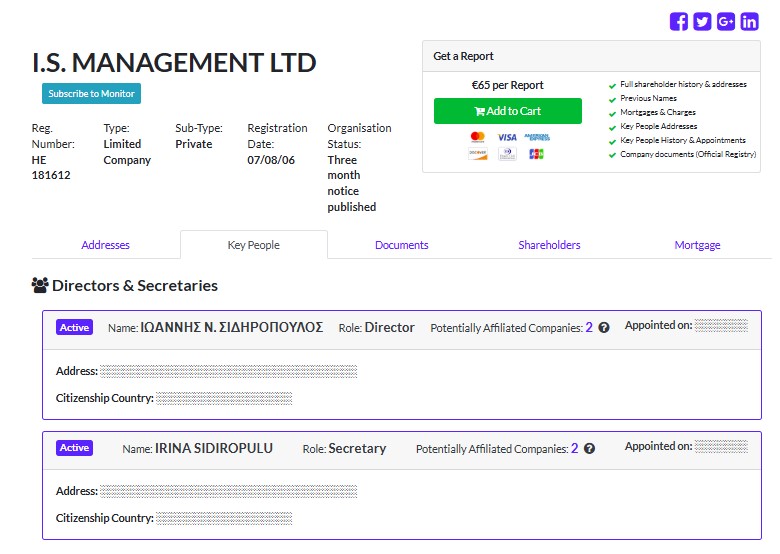
Thus, we associate shareholders 1–4 with Konstantin Sokolov and his business network.
The UBOs of Cyprus companies 5–7 remain the mystery.
Shareholders 8–9: Mangrove Group — among the very first investors.
Interesting facts about Mangrove.
- Mark Tluszcz, founder of Mangrove Capital Partners, was a board member of TBOL Holdings UK Limited from 25 April 2018 — long before the public launch of the bank in November 2021 — and remained a director until 7 April 2026, when he left the board. Yet Mangrove entities — Mangrove V and Mangrove VI Investments Sarl, both managed by Tluszcz and Hans-Jürgen Schmitz — appear among the shareholders identified above. Tluszcz left the board; Mangrove remained in the capital.
- Mangrove Capital Partners and Index Ventures were among the early investors in Skype — before its sale to eBay in 2005. Giuseppe Zocco, co-founder of Index Ventures, is the spouse of Stephanie Rada Zocco, who joined the Board of Trustees of the University of Chicago together with Konstantin Sokolov. https://ksokolovarchive.cc/2026/09/10/uchicago-1-3-reputation-for-sale-sokolov-and-four-new-trustees/
Don’t Mess with the US Donator
Bank of London was never meant to make money. It was meant to be owned.
For Konstantin Sokolov — a Russian financier who donated his way into the US elite after the Ukraine invasion — this is not new. A strange bank, a messy balance sheet, a licence worth having — and then, quietly, a rewrite of the books, a change of name, a new face. We have seen it with the Armenian AMIO Bank. We are seeing it again here.
But look at the structure. Old investors stay. New ones appear. Sokolov’s people slip in between them. Nobody owns more than 25%. Nobody appears to control the bank — on paper. A perfectly fragmented cap table where no single name has to be disclosed.
And yet, decisions are made. Somebody is making them.
That is not a bank. That is a collection point — divided, diluted, and very carefully arranged.
Credits:
- Bank of London resolves tax payment glitch, raises funds
https://www.reuters.com/business/finance/bank-london-resolves-tax-payment-glitch-raises-funds-2024-09-09/ - PRA fines The Bank of London and Oplyse Holdings — £2M settlement, breaches between 7 October 2021 and 22 May 2024, fabricated documents, first-ever integrity fine.
https://www.bankofengland.co.uk/news/2026/march/pra-fines-bol-and-oplyse-holdings - Bank of London final 2025 results announcement — official press release with financial highlights.
https://www.bankoflondon.com/resources/bank-of-london-final-2025-results-announcement - Diane Gray-Smith’s Biography
https://people-qa.equilar.cloud/bio/person/diane-gray-smith-sts-capital-partners-securities-inc/30155518 - CB Insights — Tbol — lists Mangrove Capital Partners as the only recorded investor.
https://www.cbinsights.com/company/tbol - The Banker — “under new ownership,” £57M Mangrove-led funding, £25M commitment.
https://www.thebanker.com/content/6ee3c93b-52f6-4ef7-935a-61423d9df960 - This is Money — Anthony Watson profile, “banker taking on the Big Four.”
https://www.thisismoney.co.uk/money/markets/article-10274697/Anthony-Watson-banker-taking-Big-Four.html - CFA UK — “There are no openly LGBT+ people leading a FTSE100 company” — Watson interview on Pride, diversity, AI.
https://www.cfauk.org/pi-listing/there-were-no-openly-lgbt