Tag: Bank of London

  • Sokolov’s Shadow: The Register That Pulls All TBOL Members Into the Light

    October 01, 2026

    We began investigating Bank of London’s business and corporate structure a few weeks ago. Our starting point was the bank’s connection to Konstantin Sokolov, traced through his affiliated Swiss financiers — Alfred Moeckli and Ariel Sergio Davidoff — and through the Q2 2026 corporate resolution signed by TBOL members, including Sokolov himself and his mother.

    TBOL Holdings Jersey Limited, registration number 151277 was identified as the sole upper holding company — the entity whose board members are the ultimate decision-makers for the entire TBOL group, including the operating bank.

    At first, the shareholder structure of the Jersey-registered company was unavailable to us. Jersey — for those unfamiliar — is a Crown Dependency in the Channel Islands, not part of the United Kingdom, with its own company law and its own registry. We did not know where to look, or whether the information was accessible at all. Then our lawyers read the local legislation. And here is what they found – obtaining a shareholder register from a Jersey-registered company is remarkably easy.

    Under Article 45(1) of the Companies (Jersey) Law 1991, the register of members must be open to inspection by any person during business hours, on payment of a fee not exceeding the published maximum.

    45      Inspection of register

    (1)     The register of members shall during business hours be open to the inspection of a member of the company without charge, and of any other person on payment of such sum (if any), not exceeding the published maximum, as the company may require.

    (2)     A person may –

    (a)     in the case of any company, on payment of such sum (if any), not exceeding the published maximum, as the company may require; and

    (b)     in the case of a public company, on submission to the company of a declaration under Article 46,

    require a copy of the register and the company shall, within 10 days after the receipt of the payment and (in the case of a public company) the declaration, cause the copy so required to be available at the place where the register is kept, for collection by that person during business hours.

    (3)     If inspection under this Article is refused, or if a copy so required is not made available within the proper period, the company is guilty of an offence.

    (4)     In the case of refusal or default, the court may by order compel an immediate inspection of the register, or direct that the copies required be made available to the person requiring them.

    Our lawyer sent a request to registry@jerseyfsc.org on TBOL Holdings Jersey Limited register of members and received a short reply confirming that the register is kept at the company’s registered office and is available upon request. They asked whether it could be provided electronically. It could. Within a few hours, the PDF of TBOL Holdings Jersey Limited register of members as of June 18, 2026 was in our inbox (download). Nor, to our surprise, was there any fee to pay.  Let’s see it.

    Who is The Big Man?

    We have no idea why Konstantin Sokolov decided to become the largest individual shareholder in a UK bank — but he did.

    It is also unclear why the register lists personal residential addresses for both Sokolov and his mother, rather than a corporate or nominee address, as is customary for shareholders of this size — or any of the US business addresses associated with his companies, such as IJS Investments or Dynamic Frontier. Sokolov’s registered address is residential, on Malta; his mother’s is a residential address in Gibraltar. We are not publishing the specific addresses here, but the full register — which we obtained lawfully under Article 45 of the Companies (Jersey) Law 1991 — is attached for anyone who wants to verify this themselves.

    Sokolov holds 399,122,220 ordinary shares in TBOL Holdings Jersey Limited — 8.28% of the company. His mother, Bronislava Gorelik, owns 391,263,039 shares — 8.12%. Individually, both sit just below the 10% threshold at which the PRA’s controller regime kicks in under Part XII of FSMA 2000. Together they account for 16.4%.

    For context on why a residential address matters here: this is the same Konstantin Sokolov the Guardian identified in July 2026 as founder and chairman of the U.S. State Department’s $201 million TRIPP+ Enterprise Fund — a man the paper’s sources questioned specifically over “the ability to personally benefit from investment decisions.” A quasi-governmental appointee of this profile using a home address on a bank’s shareholder register, instead of the corporate infrastructure he otherwise operates through, is the kind of detail that invites the question, not answers it.

    We would like to remind that Konstantin has a highly promising investment project — Pelagos Data Centres in Gibraltar — which we have written about many times. Just type PELAGOS in the search bar of our blog or click 1, 2, 3, 4, 5.

    Add the two Cyprus companies the document itself flags as connected to Sokolov — ANALIKA LIMITED (9.41%) and ELISCANOUS LIMITED (4.81%) — and the bloc reaches 30.62%. The Sokolov link to ANALIKA and ELISCANOUS is our assessment (see our previous article), not the filing’s. The record shows names and shares — not ownership chains.

    What the filing does confirm independently: of the 72.29% (2/3+) of shares that voted in favour of the 2Q 2026 capital resolution, the voting weight is concentrated in three shareholder groups — assuming the “probable connection” holds:

    1. The Unattributed Group (first 3 members): Soata Limited + Buscelo Limited + PSInvest Capital Ltd — 28.63%
    2. Sokolov’s Group (our opinion): Sokolov + Gorelik + Analika + Eliscanous — 30.62%
    3. Tluszcz’s Group: Mangrove VI Investments Sarl + Mangrove V Investments Sarl — 12.99%

    Anatomy of the Members: 55 Shareholders, Eight Countries, One Extraordinary Year

    TBOL Holdings Jersey Limited has 55 shareholders. None of them holds 10% or more. The largest shareholder is Soata Limited with 9.635%. This keeps each holder below the 10% threshold at which the PRA’s controller regime would apply.

    By geography, the ownership of Britain’s newest clearing bank looks nothing like Britain.

    JurisdictionHoldersShare of capital
    Cyprus542.9%
    United States3119.7%
    Luxembourg617.0%
    Malta216.4%
    Cayman Islands12.5%
    Jersey11.3%
    Bermuda10.3%
    United Kingdom30.01%

    Five Cyprus-registered companies alone hold  42.9% shares of Bank of London that is more than every American venture fund that financed its launch, combined.  

    By type of holder, the register splits into 28 individuals, 14 companies, 10 funds, 3 charitable trusts/foundations.

    By timing, the current cap table is far younger than the bank. Nearly 60% of it traces to just two quarters: Q2 and Q3 2025. That’s not when Bank of London launched (2021), and not when the April 2026 resolution was passed — it’s the window in which most of today’s ownership was quietly assembled, more than half a year before the public first saw any of these names.

    The Participants We Flagged

    Shaun Woodward — holds 8,572 shares (0.0000018%). A real, well-known former politician. Secretary of State for Northern Ireland (2007–2010), former Labour MP, and before that a Conservative MP who defected to Labour in 1999. He left the Conservative Party partly over its stance on LGBT rights.

    Anthony Watson still holds 490,028 shares — 0.0001% of the company he founded. Five funding rounds and several ownership restructurings later, the man whose name is on the bank’s early press coverage owns a rounding error.

    Victoria Raffé — holds 276 shares (0.00000006%). Former Director of Authorisations at the FCA, 20 years at the regulator (FCA/FSA), member of the Executive Committee, Chair of the Regulatory Transactions Committee, left in April 2015. She also served as a Director of The Bank of London Group Limited from November 2021 to October 2023 — before the change of control. After that — non-executive director at Starling Bank (a direct competitor of Bank of London!) and Reliance Bank.

    Armen Grigoryan — holds 110 shares (0.00000002%). Secretary of the Security Council of Armenia from 2018 to August 2026, also Acting Foreign Minister in July–August 2021. Senior Advisor at PMCG, working on TRIPP. And that last point is the one that matters most. Konstantin Sokolov is the president of the TRIPP+ Enterprise Fund — a $201 million US State Department-backed vehicle for infrastructure projects in the South Caucasus. Grigoryan, a former Armenian security chief, now advises on TRIPP. This is not a “possible connection.” It is a direct intersection — the same project, the same fund, the same network.

    Shaunt Sarkissian holds 4,888 shares (0.0000010%). Founder of Cortex MCP, later Head of Payments at Uphold and Chief Markets Officer at Bank of London. His father, Vahe Sarkissian, holds 8,677 shares (0.0000018%). Vahe is a Silicon Valley semiconductor veteran and former CEO and Chairman of FEI Company. Both are American entrepreneurs of Armenian heritage.  In 2018, Uphold acquired Cortex MCP — explicitly including its patent portfolio. Today, part of that technology sits inside the Bank of London corporate structure. We’ll come back to the patents later — and what they reveal about Bank of London’s technology — in a separate piece.

    If you have found anyone else worth a second look, tell us. We will happily add them to the list.

    Credits:

  • Sokolov’s Shadow: 25% for Companies House vs 10% for the PRA

    September 24, 2026

    On 17 September 2026, we published Sokolov’s Shadow: The “Straight Man” Behind Bank of London’s Cleanup. That piece identified nine shareholders holding more than two-thirds of the shares in TBOL Holdings Jersey Limited (registration number 151277) — the ultimate parent of Bank of London.

    In that article, we noted that each shareholder holds less than 25% — the disclosure threshold for Companies House. Four of them — Konstantin Sokolov, Bronislava Gorelik, ANALIKA, and ELISCANOUS — appear in the same register. Whether they act in concert is a separate question.

    The Bank Control Question

    For Companies House, the disclosure threshold for a controlling shareholder is 25%. That is the threshold our earlier piece addressed. But for the Prudential Regulation Authority (PRA), the relevant threshold is far lower: 10%.

    Under Part XII of the Financial Services and Markets Act 2000 (FSMA), a person becomes a “controller” of a PRA-regulated firm — triggering mandatory notification and prior approval requirements — once they hold 10% or more of the shares or voting power in the firm or its parent undertaking. Crossing 20%, 30%, or 50% requires separate, additional approval each time. Proposed controllers must be assessed by the PRA for financial soundness and fitness and propriety before the acquisition takes effect — not after.

    We do not know the actual percentage held by any of the nine shareholders named in the April 2026 resolution. TBOL Holdings Jersey Limited does not publicly disclose that breakdown, and we have not seen any document that does. One possible explanation for a structure involving multiple family members and affiliated entities is that it can result in individual holdings remaining below a regulatory disclosure threshold. We are not suggesting that this is what happened here. Without the underlying capitalization table, any specific percentage — 7%, 15%, 30% — would be a guess dressed up as a calculation. What we can say is narrower: a British bank’s ultimate ownership structure includes a family grouping and several Cyprus-registered entities whose combined position relative to the 10% PRA threshold is currently unknown to the public — and, as far as we can determine, to us.

    UK-regulated firms are subject to a statutory controller regime requiring relevant controllers and changes in control to be notified to the appropriate regulator. Under Section 398 of FSMA, knowingly or recklessly providing the PRA with false or misleading information on a material matter is a criminal offence.

    Watson v ForgeLight: What Caseboard.io Shows

    In our previous article, we did not mention one important detail: at the early stage of financing in 2021, alongside Mangrove Capital Partners, the launch of the innovative bank was also backed by ForgeLight — a US investment firm based in Miami, founded by former Viacom CFO Wade Davis, which led the $90 million round in November 2021 — and 14W Venture Partners, a US venture capital firm that co-led the February 2023 extension.

    While monitoring Caseboard.io, we came across a court record identified as BR-2025-000907, Watson v ForgeLight Holdings LP.

    We should, however, make clear that we have not independently verified the information contained in the Caseboard.io entry. Accordingly, the screenshots are retained for transparency and as a record of what was publicly displayed on the platform at the time of publication. The entry should not be understood as establishing the nature or outcome of the proceedings.

    Further information is expected to become available in Q1 2027.

    (!) Updated screenshot from caseboard.io, 25 September 2026 — case details have changed.

    TBOL: The Strong Decision 2026

    Against the backdrop of everything we have gathered, the bank is undergoing serious changes. The Group Board announced and media dutifully repeated the news that it has been strengthened with the appointment of Noah Sharp as an Independent Non-Executive Director. Even The Banker wrote about it — Chris Newlands, a regular chronicler of the bank’s fortunes, covered the appointment in an article “Former NatWest non-executive director joins Bank of London board“. But Newlands did not mention one thing: after a long career at Deutsche Bank that ended 2018, Noah Sharp spent the rest of his professional life never staying anywhere longer than two years (Vodeno, NatWest Boxed, BCB Group, Paysafe (2.5Y), Standard Chartered).

    Place your bets on whether his tenure at TBOL will last longer.

    Rumoured Investors, Off the Register

    In September 2024, Sky News reported:

    “The new funding is understood to be being lined up from a number of investors including an entity called Aphorism Holding, according to the person.”

    “Nada Hadadi, a wealthy investor who was suggested as being the primary source of the capital, has in fact only contributed a six-figure sum.”

    The Financial Times, in September 2024, also reported on a mystery investor whom even the FT could not identify:

    “The plot thickened on Saturday as rumours swirled about a mystery investor who was identified as both Nasser Hadidi and Nada Hadadi (if you know anything about this mystery man, do let us know, because we certainly have never heard of him).”

    Compliance Corylated published two investigations in 2026 into the Bank and its investors, based on rumours. Both have since disappeared from their original URLs, surviving only in the Internet Archive.

    What Britain Actually Regulates For

    None of this is an argument against Bank of London existing, or against ambition. A modern clearing bank in London is a genuinely good idea — the UK could use more of them, and we’d like to see this one work. That’s not sarcasm.

    But “good idea” and “good business” aren’t the same thing, and neither excuses what British financial regulation is designed to prevent: situations in which disclosure, control and regulatory oversight become unclear or difficult to verify. A jurisdiction that took hundreds of years to build a reputation for rule-following doesn’t get to relax that standard just because the pitch deck says “fintech” instead of “merchant bank.”

    If the questions raised by Bank of London’s documentation, opaque ownership and financing history have innocent explanations — fine, let the PRA say so and clear the record. But if they amount to something, the consequence should land wherever the facts point, regardless of whose name is attached, how well-connected they are, or who they had dinner with once. That’s not a grudge against one bank. It’s the only version of “regulated” worth the word.

    Very soon, we’ll go further down the rabbit hole — everything we uncover is legal and based on public information — and take a closer look at who owns what behind TBOL Holdings Jersey Limited. Stay tuned.

    Credits:

  • Sokolov’s Shadow: The “Straight Man” Behind Bank of London’s Cleanup

    September 17, 2026

    Bank of London is a British clearing bank and fintech company. It launched in November 2021 as the UK’s sixth principal clearing bank, entering the market with a $1.1 billion valuation.

    Historically, the UK’s clearing market was dominated by four major banking groups: Barclays, HSBC, Lloyds and RBS (now NatWest). They were later joined by ClearBank and, in 2021, by Bank of London (also known as The Bank of London; TBOL).

    An AI illustration inspired by the architecture of 77 Cornhill, London

    From the two 2025 audited reports of THE BANK OF LONDON GROUP LIMITED and its parent company, TBOL HOLDINGS UK LIMITED, filed with Companies House as of 18 August 2026 (PDFs available at the links above):

    Going concern:

    “The Board recognise that, notwithstanding the commitment and ability of ultimate parent company shareholders to inject capital… a material uncertainty over going concern exists as a result of additional funding requirements and there are significant doubts about going concern.”

    Qualified audit opinion from EY — two red flags:

    Share-based payments: “Owing to significant turnover of staff and inadequate record keeping creating challenges to the retrieval of historical data, the Directors have been unable to conclude on the completeness, accuracy and disclosure of the share-based payment scheme records.”

    Employment tax liabilities: “The Directors have also estimated the valuation, and based the accounting and disclosure of employment tax provisions arising from benefit in kind payments to employees, on the information they had available because of inadequate historical records.”

    Office closures and legal claims:

    “In October 2025, the Board decided to exit the Group’s Belfast office… impacted roles either relocated to London or transitioned to an outsourcing partner.”

    “Provision in respect of a lease termination dispute… estimated exposure approximately £600k. Paid £129k into the Northern Ireland court… final settlement uncertain.”

    The New York office was closed early. The London office at 77 Cornhill is the only one remaining, with the lease extended until 2031.

    Anthony Watson Achievement: Britain’s First Gay Bank Founder

    Anthony Watson’s story is not one of inherited privilege or a straight-line career. It is a story of a technologist who talked his way into banking, built a crypto exchange, and then founded a bank — while becoming one of the most visible LGBT+ figures in British finance.

    His first job was in technical support at AOL Europe, followed by First-e (Europe’s first internet bank), Microsoft, later CIO for Europe/Middle East at Barclays, where he co-founded the global diversity & inclusion panel. Then Uphold/Bitreserve (a crypto platform startup).

    He founded the project that launched as The Bank of London in November 2021. Companies House records show that Watson was a person with significant control and retained a 25–50% shareholding until April 2025. But Watson was not the one doing the quiet work. His key partner, Diane Elizabeth Gray-Smith, was the finance professional behind the early execution. As CFO at Uphold — the entity from which The Bank of London later emerged — she secured the Small Specialist Banking licence from the Bank of England before the 2021 launch.

    Watson was the first British citizen on the board of GLAAD (since 2013), ambassador for the charity Stonewall, chairman of the European Diversity Awards. In June 2023, he received a CBE “for services to the LGBT community, equality and diversity”. A Bank of London statement celebrating the award described him as ‘Britain’s only gay bank CEO’ and ‘the first LGBT person in Europe to found a bank.  It’s perhaps no surprise that with an openly gay CEO around 30% of senior leaders at The Bank of London identify as LGBT+. The Bank of London seeks to attract the “best diverse candidates for roles,” says Watson. “We don’t care if you’ve gone to university or not.”

    According to an investigation by The Critic, Watson donated £340,000 to Labour and Labour politicians. The largest recipient of his donations was Dawn Butler, Shadow Equalities Minister; in 2018, she made him the head of her equality advisory committee.

    Thus, Watson was the key founder and public face of the project, which had been developed for several years before The Bank of London launched in 2021. He stepped down as CEO in September 2024, as the bank entered a period of mounting financial and regulatory difficulties. He remained a shareholder and founder, however, and Companies House records show that he retained a 25–50% shareholding until April 2025.

    Watson lost not only the bank, but the “The” in its brand. “The Bank of London” remains a registered trading name, but in the bank’s current logo and public communications, the “The” has been cut off — leaving simply “Bank of London” (rebranded by Conran Design Group in Q2 2025).

    The Unicorn Bank Fed and Bled by Investors

    Watson was the face of the bank. But the financing came largely from outside investors. And among the investors behind the project, one name appears particularly early — Mangrove Capital Partners. Mangrove was involved with TBOL long before the Bank of London became a public-facing banking brand. CB Insights, a commercial database that tracks private companies, funding rounds and investors, lists Mangrove Capital Partners as the only recorded investor for a separate entry for the company “Tbol.” The dates attached to that database entry are inconsistent, so they should not be treated as definitive proof of an investment in 2018. But the connection is consistent with Mark Tluszcz, Mangrove’s managing partner, joining the company’s board on 25 April 2018. That makes Mangrove an interesting starting point for tracing where the money behind the Bank of London actually came from.

    November 2021 — $90 million Series C; $120 million raised to date. The Bank of London launched publicly with a $1.1 billion valuation, becoming what was described as the first pre-revenue bank to achieve “unicorn” status at launch. The latest round raised $90 million, led by ForgeLight, with follow-on investment from 14W Venture Partners and Mangrove Capital Partners. The company said it had raised $120 million in total by that point, with additional investment committed over the following 18 months.

    February 2023 — $40 million Series C extension. The new round came from existing investors and brought the reported total raised to $160 million. Mangrove Capital Partners and 14W Venture Partners co-led the round, with ForgeLight also participating. Alex Zubillaga, managing partner of 14W and a Bank of London board member, was quoted on the transaction. Mark Tluszcz was identified as both managing partner of Mangrove and a board member of The Bank of London.

    A coincidence worth noting. In February 2023, Harvey Schwartz became CEO of Carlyle Group — the firm co-founded by David Rubenstein, who also appears in our UChicago article. At the same time, Schwartz was Group Chairperson of The Bank of London. He had been associated with the bank since its launch.

    August 2024 — £42 million funding round led by Mangrove. The round was closed in August, shortly before the HMRC issue became public. Mangrove Capital Partners led the oversubscribed round, making it the lead investor at a critical point in the bank’s history. The funding was announced on 9 September — after Watson’s departure and almost simultaneously with the HMRC controversy. The money was raised before the crisis, not alongside it.

    September–October 2024 — the crisis becomes public. The bank faced an HMRC winding-up petition over unpaid taxes, while founder Anthony Watson stepped down as CEO and moved into an advisory role. Stephen Bell became CEO. The bank subsequently faced further scrutiny over its governance and capital position.

    2025 — restructuring under new control. By the time the bank’s later accounts were being discussed publicly, the company described itself as operating under new ownership, having secured £57 million of Mangrove Capital-led funding, with a further £25 million committed. That £42 million was part of a broader £57 million injection from new owners led by Mangrove. The new management described the period as a comprehensive transformation of the business.

    The Bank That Never Made a Penny

    The 2025 accounts show the scale of the problem. The Bank of London Group Limited, the operating bank, reported a £23.5 million loss in 2025, following a £23.9 million loss in 2024.

    At the Group level, the numbers are even worse. TBOL Holdings UK reported total income of approximately £6.4 million — including only £2.6 million in fee income — against a £27.0 million loss for the year. In 2024, the Group lost £46.9 million.

    The bank operates a full-reserve model: it does not lend, and all client monies are held in full and unencumbered at the Bank of England. Its revenue is primarily fee-based, supplemented by interest income.

    The contrast with the original launch story is striking. The bank entered the market with a $1.1 billion valuation, $120 million already raised, and plans to hire more than 3,000 people across the UK, Europe and North America. By 2025, the Group had approximately 86 employees, had never generated an annual profit, and had accumulated losses approaching £180 million.

    Who Are Today’s Owners Trying to Fix This?

    OPERATING ENTITY LICENSED BY PRA – FRN 930379   — THE BANK OF LONDON GROUP LIMITED, Company number 12844788 (formerly TBOL UK HOLDINGS LIMITED, 28 Aug 2020 — 08 Nov 2021).

    One active person with significant control is indicated: TBOL Holdings UK Limited.

    Current directors, according to Companies House — all six are also listed on the Bank’s official website:

    • BULLMAN, Antony George (CEO);
    • CARAWAN, Mark John (Independent Non-Executive Director & Chair of the Audit Committee);
    • HOWIE, Thomas Paul (General Manager & Executive Director);
    • MELIS, Anna Monique (Chairperson of the Board & Non-Executive Director);
    • MOECKLI, Alfred Walter (Non-Executive Member of Board);
    • WALKER, Simon Richard (Non-Executive Member of Board & Chair of Board of Risk Committee).

    PARENT HOLDING COMPANY – TBOL HOLDINGS UK LIMITED, Company number 10511092. Former names: OPLYSE HOLDINGS LIMITED (11 Mar 2025 — 20 May 2026); THE BANK OF LONDON GROUP HOLDINGS LIMITED (12 Oct 2022 — 11 Mar 2025); TBOL LIMITED (25 Apr 2018 — 12 Oct 2022); TBOL PLC (08 Nov 2017 — 25 Apr 2018); UPHOLD GROUP PLC (05 Dec 2016 — 08 Nov 2017).

    No active persons with significant control identified.

    Only current officers: DAVIDOFF, Ariel Sergio, Dr (Appointed on 27 April 2026); MOECKLI, Alfred Walter (Appointed on 7 April 2026).  Subscribers of our blog are already familiar with Swiss executives who have long-standing partnerships with Konstantin Sokolov and connections to Armenian AMIO Bank (1, 2). A quick look into the blog archives makes it clear: where you find this man, you find Konstantin Sokolov’s fingerprints.

    A small off-topic that helps better understand the shareholder composition below. In our blog, we have always associated Cypriot companies under Konstantin Sokolov’s control with the administrative company GIF Capital LTD (Cyprus), offering administrative services, with Iryna Sidiropulu as the key officer. According to the investigation by hetq.am (our English translation at the link), Konstantin Sokolov’s mother is Bronislava Gorelik. She appears personally as a director in the Cypriot companies IFG Basis Capital Limited (Cyprus, HE 454994) and BASIS CAPITAL INTERNATIONAL FINANCIAL GROUP LTD (Cyprus, HE 454996), but the secretary of these companies is CAPLATINE SECRETARIAL LTD. The parent structure, Caplatine Ltd (Cyprus, HE 450799) was established recently, on 30 August 2023, and is officially a licensed Administrative Service Provider (ASP) under the direct supervision and regulation of the Cyprus Bar Association (website).

    UPPER HOLDING COMPANY — TBOL HOLDINGS JERSEY LIMITED, Registration Number: 151277. Previous names: TBOL GROUP & HOLDINGS CORPORATION LIMITED (01/11/2023); FELLESSKAP GROUP & HOLDINGS CORPORATION LIMITED (11/02/2025 — 22/05/2026). Shareholders and owners are not disclosed in the public register. But the audited report 2025 of its UK subsidiary makes the power structure clear:

    “The long term and strategic decision making for the organisation is the responsibility of the Company’s parent company, TBOL Holdings Jersey Limited, and the Group Board implements the decisions made by the Board of TBOL Holdings Jersey Limited.”

    And now the most interesting part — our blog has obtained corporate records from Q2 2026 that allow us to determine with a high degree of certainty the controlling shareholder pool of TBOL HOLDINGS JERSEY LIMITED, with each shareholder holding less than 25% of the shares (below the threshold requiring disclosure).

    TBOL HOLDINGS JERSEY LIMITED SHAREHOLDERS:

    1. KONSTANTIN SOKOLOV
    2. BRONISLAVA GORELIK
    3. ANALIKA LIMITED (Cyprus, HE 456247) — director Adamos Adamides, who is also a director of CAPLATINE SECRETARIAL LTD; secretary: CAPLATINE SECRETARIAL LTD.
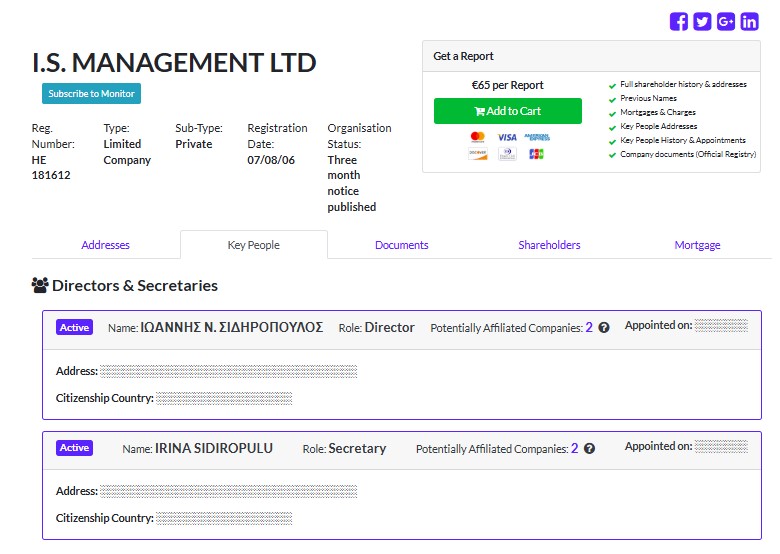
    4. ELISCANOUS LIMITED (Cyprus, HE 446650)— director Ioannis Sidiropoulos (same surname — relative (?) of Irina Sidiropulu (GIF Capital), together they manage I.S. MANAGEMENT LTD (Cyprus, HE 181612), secretary ALNIA SECRETARIAL LIMITED (see above, associated with Caplatine Secretarial Ltd.)
    5. PSINVEST CAPITAL LIMITED (Cyprus, HE 470533) — director and secretary Konstantinos Neophytou
    6. SOATA LIMITED (Cyprus, HE 466135) — director and secretary Kyriaki Ioannou
    7. BUSCELO LIMITED (Cyprus, HE 456243)— director and secretary Andreas Ourris
    8. Mangrove VI Investments Sarl (Luxembourg venture fund) — managers Hans-Jürgen Schmitz and Mark Tluszcz
    9. Mangrove V Investments Sarl (Luxembourg venture fund) — managers Hans-Jürgen Schmitz and Mark Tluszcz

    Thus, we associate shareholders 1–4 with Konstantin Sokolov and his business network.

    The UBOs of Cyprus companies 5–7 remain the mystery.

    Shareholders 8–9: Mangrove Group — among the very first investors.

    Interesting facts about Mangrove.

    1. Mark Tluszcz, founder of Mangrove Capital Partners, was a board member of TBOL Holdings UK Limited from 25 April 2018 — long before the public launch of the bank in November 2021 — and remained a director until 7 April 2026, when he left the board. Yet Mangrove entities — Mangrove V and Mangrove VI Investments Sarl, both managed by Tluszcz and Hans-Jürgen Schmitz — appear among the shareholders identified above. Tluszcz left the board; Mangrove remained in the capital.
    2. Mangrove Capital Partners and Index Ventures were among the early investors in Skype — before its sale to eBay in 2005. Giuseppe Zocco, co-founder of Index Ventures, is the spouse of Stephanie Rada Zocco, who joined the Board of Trustees of the University of Chicago together with Konstantin Sokolov. https://ksokolovarchive.cc/2026/09/10/uchicago-1-3-reputation-for-sale-sokolov-and-four-new-trustees/

    Don’t Mess with the US Donator

    Bank of London was never meant to make money. It was meant to be owned.

    For Konstantin Sokolov — a Russian financier who donated his way into the US elite after the Ukraine invasion — this is not new. A strange bank, a messy balance sheet, a licence worth having — and then, quietly, a rewrite of the books, a change of name, a new face. We have seen it with the Armenian AMIO Bank. We are seeing it again here.

    But look at the structure. Old investors stay. New ones appear. Sokolov’s people slip in between them. Nobody owns more than 25%. Nobody appears to control the bank — on paper. A perfectly fragmented cap table where no single name has to be disclosed.

    And yet, decisions are made. Somebody is making them.

    That is not a bank. That is a collection point — divided, diluted, and very carefully arranged.

    Credits: